Activities for seniors
15 Easy Word Analogy Puzzles for Seniors, With Answers
Try 15 easy word analogy puzzles for seniors, with familiar relationships, multiple-choice clues, checked answers and simple read-aloud options.
What is a word analogy?
A word analogy compares two pairs that share the same relationship. Merriam-Webster describes an analogy as a comparison based on resemblance in a particular aspect and shows the puzzle pattern ICE is to COLD as STEEL is to HARD. In this activity, the task is to identify how the first pair is connected and choose the word that creates the same connection in the second pair.
Read each line as ‘A is to B as C is to blank.’ A player may say an answer, point to a choice, write it or ask for the relationship as a hint. The North Simcoe Muskoka Specialized Geriatric Services activity toolkit also presents analogies as a word activity that can be read aloud one at a time, with answers spoken or written.
These 15 puzzles were created for this article and are not sample pages from the linked Growth Lab Press books. Each item has one intended answer among its three choices, followed by a relationship check.
Round 1: familiar pairs
Choose the word that completes the second pair in the same way as the first pair.
- 1. BIRD is to NEST as BEE is to ___. (HIVE, HONEY or FLOWER)
- 2. HAND is to GLOVE as FOOT is to ___. (SHOE, SOCK or FLOOR)
- 3. PEN is to WRITE as SCISSORS is to ___. (FOLD, CUT or DRAW)
- 4. PUPPY is to DOG as KITTEN is to ___. (CAT, CUB or CALF)
- 5. CAR is to ROAD as TRAIN is to ___. (STATION, TRACK or TICKET)
Show answers or guidance
1. HIVE: a bird lives in a nest; a bee lives in a hive. 2. SOCK: a glove is worn on a hand; a sock is worn on a foot. 3. CUT: a pen is a tool used to write; scissors are a tool used to cut. 4. CAT: a puppy is a young dog; a kitten is a young cat. 5. TRACK: a car travels on a road; a train travels on a track.
Round 2: people, measures and parts
Name the relationship first if that helps, then choose the matching word.
- 6. BAKER is to BAKERY as LIBRARIAN is to ___. (LIBRARY, BOOK or READER)
- 7. CLOCK is to TIME as THERMOMETER is to ___. (WEATHER, TEMPERATURE or KITCHEN)
- 8. PAGE is to BOOK as BRICK is to ___. (CLAY, WALL or HOUSE)
- 9. APPLE is to FRUIT as CARROT is to ___. (GARDEN, ORANGE or VEGETABLE)
- 10. SMILE is to HAPPY as FROWN is to ___. (SAD, FACE or LAUGH)
Show answers or guidance
6. LIBRARY: a baker works in a bakery; a librarian works in a library. 7. TEMPERATURE: a clock measures or shows time; a thermometer measures or shows temperature. 8. WALL: a page is one part of a book; a brick can be one part of a wall. 9. VEGETABLE: an apple belongs to the fruit category; a carrot belongs to the vegetable category. 10. SAD: a smile can express happiness; a frown can express sadness.
Round 3: actions, opposites and order
The final round mixes five kinds of relationships. Use the choices to decide which connection repeats.
- 11. EYE is to SEE as EAR is to ___. (HEAR, SPEAK or TOUCH)
- 12. DAY is to NIGHT as OPEN is to ___. (DOOR, CLOSED or WIDE)
- 13. ONE is to FIRST as TWO is to ___. (PAIR, DOUBLE or SECOND)
- 14. FINGER is to HAND as TOE is to ___. (FOOT, SHOE or LEG)
- 15. ARTIST is to PAINTBRUSH as WRITER is to ___. (BOOK, PEN or DESK)
Show answers or guidance
11. HEAR: an eye is used to see; an ear is used to hear. 12. CLOSED: day and night are opposites; open and closed are opposites. 13. SECOND: one corresponds to first in order; two corresponds to second. 14. FOOT: a finger is part of a hand; a toe is part of a foot. 15. PEN: a paintbrush is a familiar tool for an artist; a pen is a familiar tool for a writer.
Check the relationship, not just the word
After choosing an answer, describe the connection in a short sentence. For puzzle 7, CLOCK and THERMOMETER are not simply household objects: each shows or measures something. TIME and TEMPERATURE complete the same relationship.
Reject an answer if it makes only a loose association. In puzzle 6, BOOK belongs with LIBRARIAN, but the first pair connects a worker with a workplace. LIBRARY therefore repeats the relationship more precisely.
Some words can have more than one real-world connection. The choices and wording define the intended answer here. If a player gives another sensible answer without using the choices, invite them to explain the relationship and treat that explanation as part of the game.
Give the relationship as a hint
Start by rereading the first pair. If a hint is wanted, name its connection without filling the blank: ‘This pair is about a home,’ ‘These are a tool and its action,’ or ‘This is a whole made from smaller parts.’
For puzzle 8, say: ‘A page is part of a book. Which choice can a brick be part of?’ For puzzle 13, count aloud: ‘One is first, two is…’ Reveal the answer whenever the player asks rather than turning the activity into a test.
To make a puzzle easier, offer two choices instead of three. To add challenge, hide the choices and ask for any word that repeats the relationship, then compare it with the intended answer.
Play aloud, with cards or in a small group
For a phone call or family visit, read one analogy slowly and pause before the blank. Repeat the choices, then repeat the full completed line after the answer. The Specialized Geriatric Services toolkit similarly recommends reading analogies one at a time and accepting spoken or written responses.
For a matching-card version, write each word on a separate card. Place BIRD beside NEST, then ask the player to place BEE beside HIVE. Use only two pairs at a time so the relationship remains clear.
In a group, let one person choose the answer and another explain the relationship. Rotate who reads, solves and checks. Keep score only if the group enjoys it; the explanation is more useful to the game than speed.
Prepare a clear large-print analogy page
Put five puzzles on a page, leave generous space between lines and keep the answer key separate. Bold the four relationship words rather than filling the page with decoration.
RNIB says large print is generally 16 to 18 point and notes that readers may need a different size. Print one sample first and ask whether the type size, contrast and spacing are comfortable before preparing all three rounds.
If print is not comfortable, use the activity entirely aloud. Say each pair slowly, repeat the choices and let the player answer with the word, its first letter or a description.
Choose more word activities by style
Our large-print activity-book guide explains how to compare readability, page layout and activity style. The memory-activity-book guide helps families choose among word games, trivia, matching activities, conversation prompts and mixed workbooks.
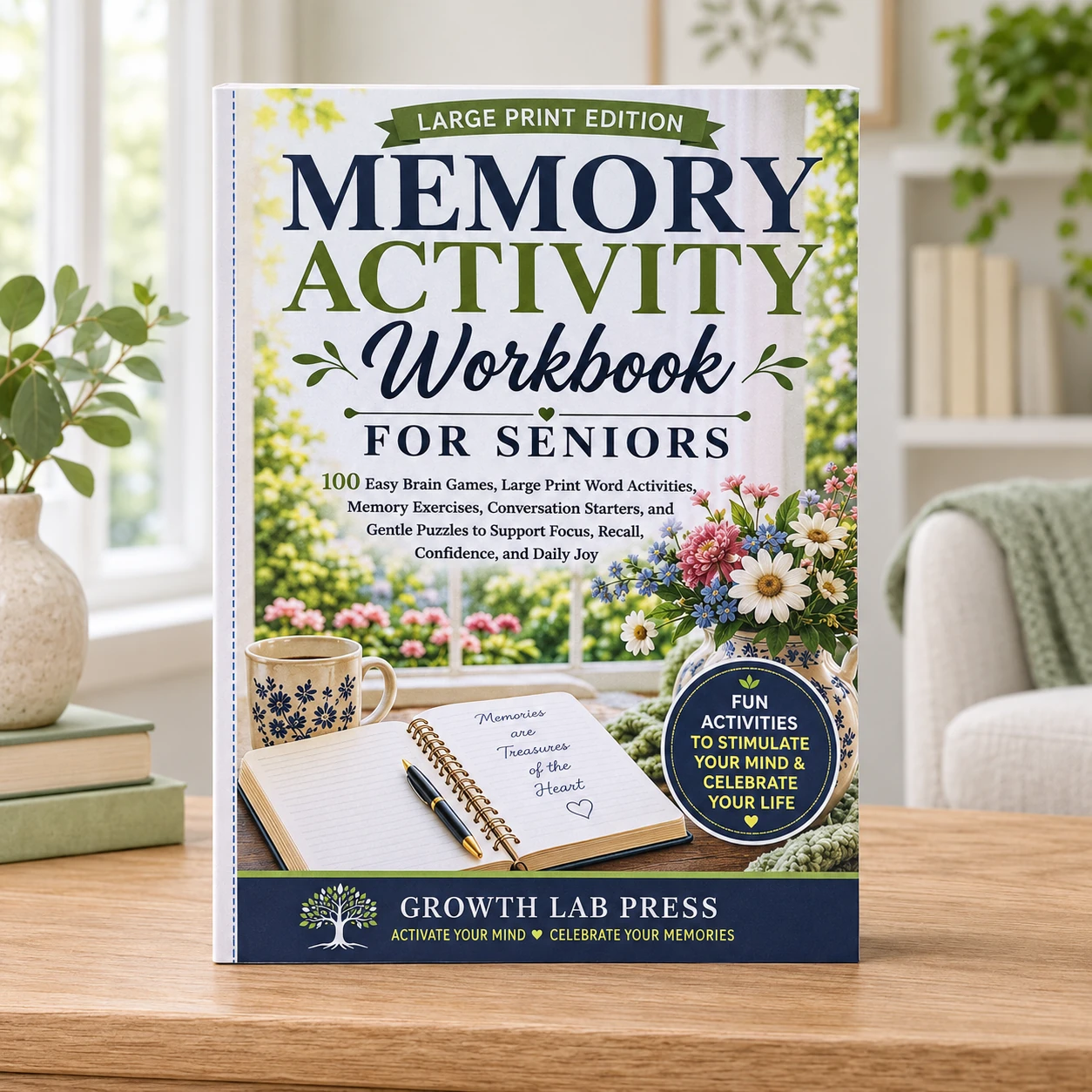
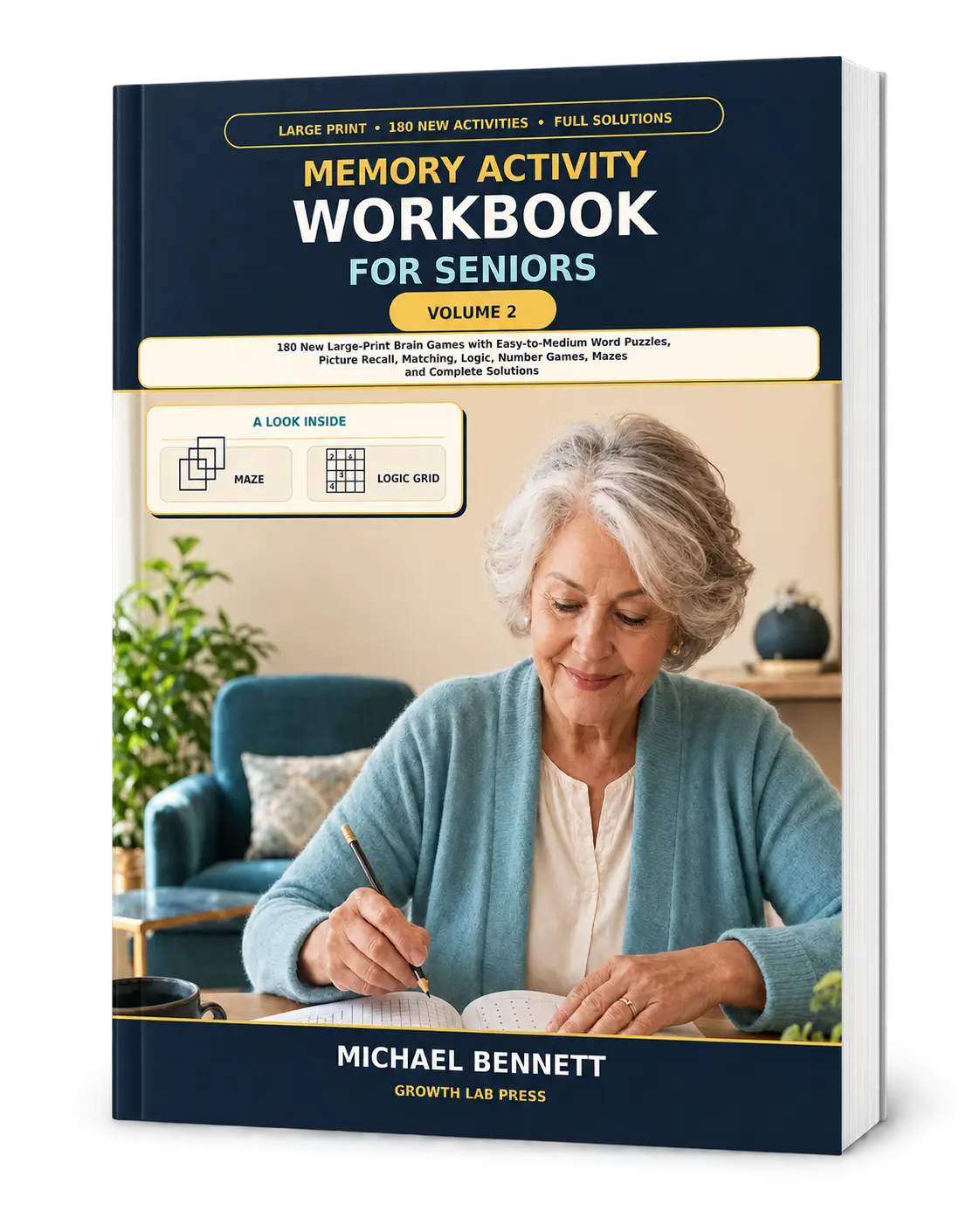
Memory Activity Workbook for Seniors includes large-print memory recall activities, word games, everyday prompts, conversation starters and reflection pages. Memory Activity Workbook for Seniors, Volume 2 contains 180 large-print word, number, matching, visual, logic, planning and maze activities with complete solutions.
The linked product pages show the current formats and contents. These 15 analogy puzzles remain a separate free activity created for this blog.
Common questions
What is an easy word analogy example?
BIRD is to NEST as BEE is to HIVE. The relationship is an animal and its home.
How do you solve a word analogy?
Describe how the first two words are connected, then choose the word that gives the second pair the same connection.
Can these analogy puzzles be played without writing?
Yes. Read one analogy and its choices aloud, accept a spoken answer, and name the relationship as a hint when needed.
Are these puzzles taken from the Growth Lab Press books?
No. They were created for this blog article and are not sample pages from either linked workbook.
Sources and further reading
Published by Growth Lab Press. Read our editorial standards.