Activities for seniors
How to Lead a Small-Group Word Game for Seniors
Use this practical small-group word game plan for seniors, with a 30-minute schedule, ready-to-play rounds, checked answers and flexible adaptations.
Choose a simple group format
Plan for one shared game rather than separate worksheets. A leader can write on a whiteboard or hold up one large-print card while the group answers aloud. This makes it possible to join without writing and gives everyone the same prompt.
Treat the activity as recreation, not a memory test. Explain that people may call out an answer, pass, help a neighbour or simply listen. Do not promise that word games prevent or treat dementia or improve memory.
The National Institute on Aging recommends matching activities to what a person can do, helping them get started, watching for frustration and allowing them to watch when that is more enjoyable. The Alzheimer's Association similarly advises focusing on enjoyment rather than achievement and adjusting activities to current interests and abilities.
Prepare the room and materials
Arrange seats so participants can see both the leader and the display without twisting. Reduce competing television or radio sound where possible. Write with a thick dark marker on a plain light surface and show only one prompt at a time.
Keep the rules to one or two sentences. Demonstrate the first answer yourself so the group sees how the round works. Put the answer sheet where the leader can check it without covering the display with corrections.
- One whiteboard, flip chart or set of large-print cards
- One thick dark marker and a spare
- A printed answer key for the leader
- A clock for pacing, not for timing answers
- Two easier backup prompts in case a round stalls
Use this flexible 30-minute word game plan
The schedule is a guide, not a rule. Stay with a round that sparks conversation, or finish early when the group has had enough. The original puzzles below were created for this article and are not sample pages from the linked books.
- Minutes 0–4 — Welcome: explain that passing and listening are always allowed.
- Minutes 4–10 — Round 1: build word lists from familiar categories.
- Minutes 10–19 — Round 2: restore the missing vowels in everyday words.
- Minutes 19–27 — Round 3: guess familiar objects from three clues.
- Minutes 27–30 — Close: ask which round the group would like to repeat another day.
Round 1: Build a familiar category list
Write one category at the top of the board and invite the group to build a list together. Begin with an easy example, then add answers in the order they are offered. Repeated answers are fine; simply point to the word already on the board and invite another idea.
Use one category for about two minutes. Do not require every person to take a turn. If the group is quiet, offer two choices: Does rose or spoon belong in the flower list?
- Flowers: rose, tulip, daisy, lily, daffodil
- Breakfast foods: toast, eggs, porridge, fruit, cereal
- Things at a railway station: train, platform, ticket, clock, luggage
- Things used in a garden: spade, gloves, hose, rake, watering can
Show answers or guidance
These are example answers, not the only correct ones. Accept any clear word that fits the chosen category, and ask the speaker to explain an unexpected answer if they would like to.
Round 2: Restore the missing vowels
Write each consonant pattern in large letters and read the clue aloud. The answer is a familiar word with A, E, I, O or U restored. Add one vowel at a time if the group wants a hint.
For example, show TPT and say: This holds and pours tea. The answer is TEAPOT. Then try the eight prompts below.
- 1. BK — It has pages and a cover.
- 2. GRDN — Flowers or vegetables may grow here.
- 3. WNDW — You can look through it.
- 4. MRKT — A place where people buy and sell goods.
- 5. PCNC — A meal eaten outdoors.
- 6. BLNKT — It keeps a bed or lap warm.
- 7. KTTL — It heats water for tea.
- 8. STRS — You walk up or down these between floors.
Check the missing-vowel answers
Each answer below keeps the consonants in the displayed order and adds only vowels. Reveal answers one at a time instead of reading the full key before the round is finished.
- 1. BK → BOOK
- 2. GRDN → GARDEN
- 3. WNDW → WINDOW
- 4. MRKT → MARKET
- 5. PCNC → PICNIC
- 6. BLNKT → BLANKET
- 7. KTTL → KETTLE
- 8. STRS → STAIRS
Show answers or guidance
The complete answer key is BOOK, GARDEN, WINDOW, MARKET, PICNIC, BLANKET, KETTLE and STAIRS.
Round 3: Guess the object from three clues
Read the first clue and pause. If nobody answers, read the second and third clues. A person may guess at any point. After the answer, invite one optional comment such as: Where would you usually keep one?
Keep the pace calm and let the group solve as a team. If two answers fit the clues, accept both and discuss what extra clue would separate them.
- 1. I have hands. I have a face. I tell the time.
- 2. I have pages. I have a spine. I can tell a story.
- 3. I have a door. I have shelves. I keep food cold.
- 4. I have a handle. I open above your head. I help in the rain.
- 5. I have bristles. I have a handle. I am used to clean teeth.
- 6. I have two wheels. I have pedals. A rider can ring my bell.
Show answers or guidance
Answers: 1. clock; 2. book; 3. refrigerator or fridge; 4. umbrella; 5. toothbrush; 6. bicycle or bike.
Make participation easy without putting anyone on the spot
Invite answers to the room instead of moving around the circle and demanding a response from each person. A participant can call out, point to a choice, help write, keep the answer cards or watch. Those are all valid ways to take part.
For a mixed group, give the clue first and then offer two possible answers only when needed. Make a round harder by hiding the clue or asking for another word in the same category. Make it easier by showing the first vowel, shortening the list or letting the group choose between two words.
If frustration, fatigue or loss of interest appears, switch to an easier prompt, invite conversation or end the game. Do not correct someone repeatedly in front of the group. A sensible alternative answer can become a useful discussion rather than a mistake.
Continue with large-print books for group activities
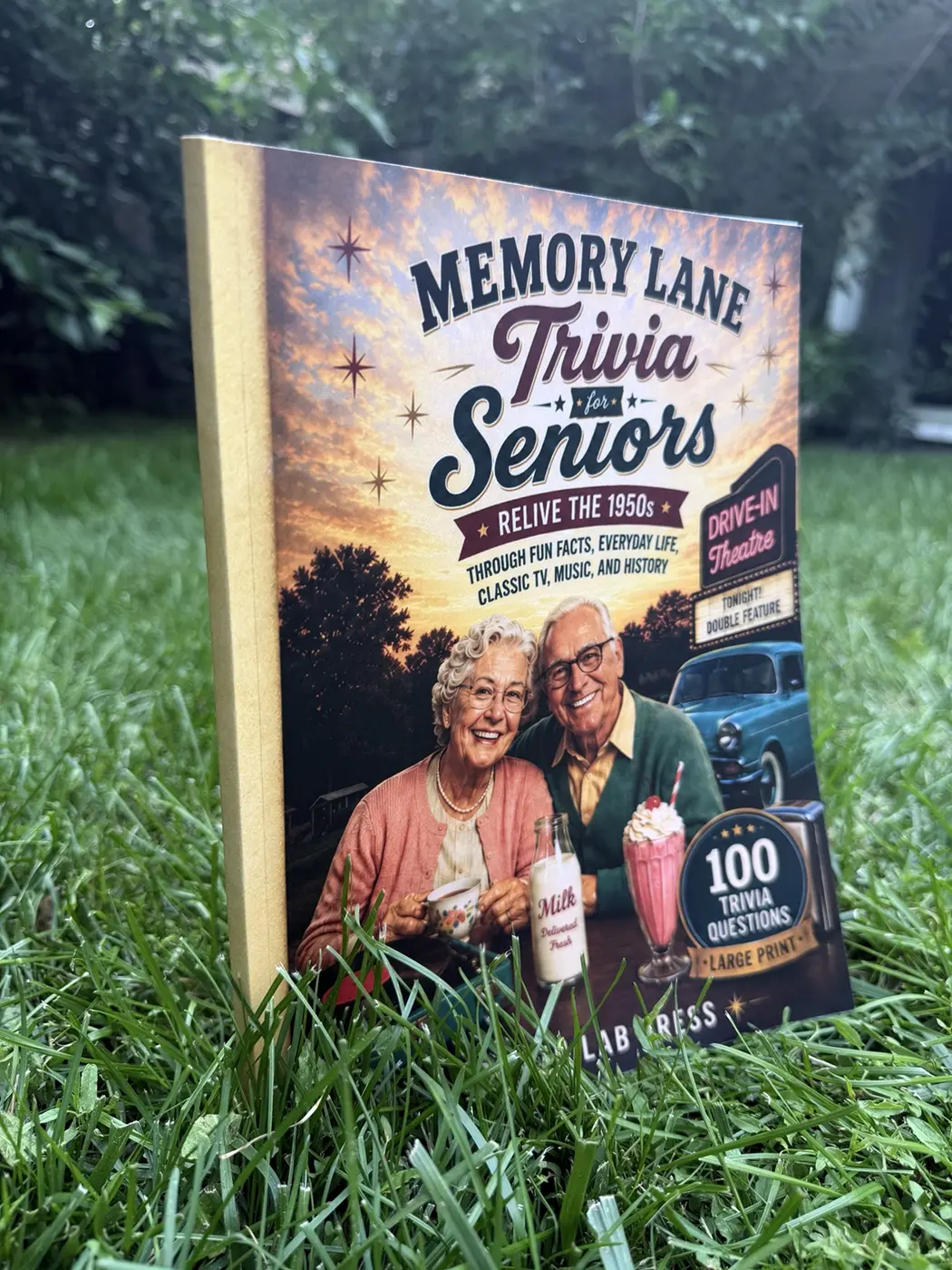
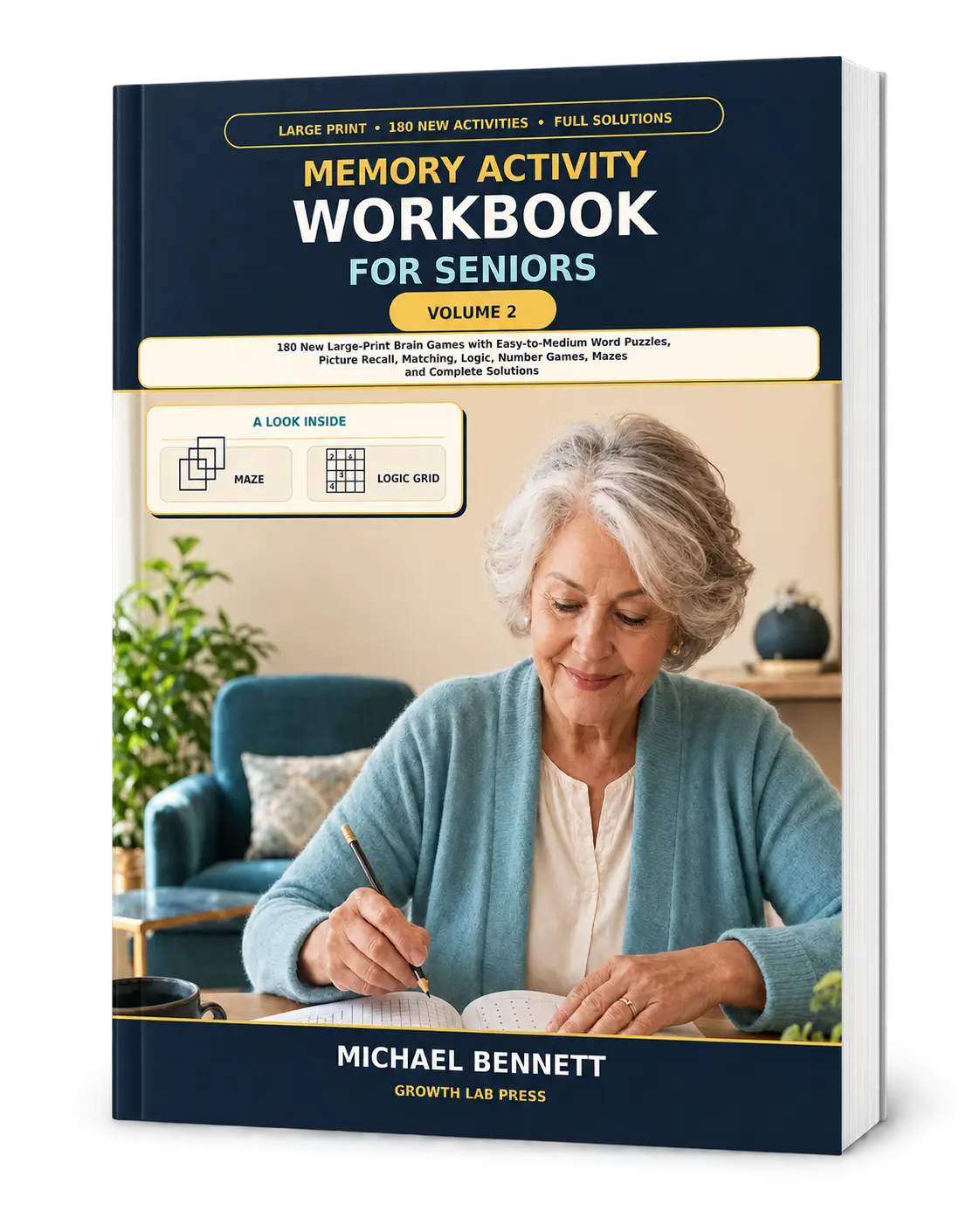
Memory Lane Trivia for Seniors contains 100 large-print questions about 1950s music, television, daily life and shared memories. Its conversation-friendly format suits solo use, family visits and activity groups. Memory Activity Workbook for Seniors, Volume 2 contains 180 large-print word, number, matching, visual, logic, planning and maze activities with complete solutions. Both books are written by Michael Bennett.
The related large-print guide explains how to compare instructions, contrast, spacing and answer guidance. The 1950s trivia guide shows how to turn factual questions into a relaxed group conversation.
Use the product links below to review the current descriptions and formats before choosing. The three rounds in this article are original blog activities and are not presented as pages from either book.
Common questions
How many people work well for a small-group word game?
There is no required number. A few people around one table can share a board comfortably, but the same rounds can work with a larger group when everyone can see, hear and choose how to participate.
Should a senior word game keep score?
Scoring is optional. For a relaxed social activity, a shared answer list and team format usually make it easier to join without pressure.
What equipment do I need?
A whiteboard or large-print cards, a dark marker and an answer key are enough. Show one prompt at a time and keep the display easy to see.
Can this word game be used with someone living with dementia?
It may be adapted for recreation, but it is not clinical advice. Match prompts to the person's interests and current abilities, allow passing or watching, stop when the activity is not enjoyable and follow the person's care plan.
Sources and further reading
Published by Growth Lab Press. Read our editorial standards.