Family storytelling
15 Questions to Ask Grandparents About Their Childhood Neighborhood
Use 15 open-ended questions to help grandparents describe childhood neighbors, streets, shops, gathering places and everyday community life.
Begin with the neighborhood your grandparent chooses
A person may have lived in several places as a child. Ask which home, street, village, farm, town or city neighborhood they would like to describe. Use their preferred place name and do not assume that the earliest home is the easiest one to discuss.
The Smithsonian oral-history guide recommends clear, concise, open-ended questions and advises interviewers to explain the purpose of the conversation. Tell your grandparent whether you are making private notes, a family recording, a map or a story page.
Ask permission before recording. Explain who may hear, read or receive the result, and make it easy to pause, skip a question or keep an answer private.
Questions 1–5: picture the street and nearby places
Choose two or three questions for the first conversation. Follow the details that matter to the storyteller rather than trying to finish the whole list.
- 1. What did you see when you stepped outside your childhood home?
- 2. How would you describe the street, road or land around your home?
- 3. Which nearby place did you visit most often, and what happened there?
- 4. Where did people buy food, collect mail or take care of everyday errands?
- 5. Which building, corner, field, park or landmark stands out most clearly in your memory?
Questions 6–10: remember neighbors and community life
Names, nicknames and relationships can help turn a general description into a family record. Ask how a name was spelled when the storyteller wants it included, and label uncertain details for later checking.
- 6. Who lived nearby, and how did your family know them?
- 7. Who was the person everyone seemed to know, and what made them memorable?
- 8. How did neighbors help one another when someone needed practical support?
- 9. Where did people gather for news, celebrations, worship, sport or conversation?
- 10. What sounds, smells or seasonal sights made the neighborhood feel familiar?
Questions 11–15: explore play, work and change
The Smithsonian's suggested community questions include what people did for a living, where local gatherings happened and how a place changed. The prompts below keep the focus on your grandparent's own experience.
- 11. Where did children play, and what rules or boundaries did adults give them?
- 12. How did you travel to school, shops, friends or family?
- 13. What kinds of work did people nearby do, and which job did you notice most?
- 14. What local event, weather day or community change do you remember especially well?
- 15. If you could walk through that neighborhood once more, where would you go first and what would you want to notice?
Use short follow-ups that invite a fuller story
Ask one question at a time and allow silence while the person thinks. The Smithsonian advises listening without interrupting and using follow-ups such as who, what, when, where, how and why instead of leading the answer.
Useful follow-ups include: 'What happened next?', 'Who was with you?', 'What did that place look like?', 'How did you feel about it then?' and 'What would a younger family member not understand about that neighborhood today?'
Do not turn a remembered story into a test. If a date, street name or sequence is uncertain, record it as approximate and check maps, photographs, directories or family documents separately.
Make a simple childhood neighborhood sketch map
The Smithsonian question guide suggests drawing a map of a local community or neighborhood. Put the childhood home near the centre of a blank sheet, then let your grandparent choose what to add: a road, neighbor's house, shop, school, place of worship, field, bus stop or gathering place.
The map does not need to be to scale. Use arrows for routes and short labels such as 'walk to school' or 'Mrs. Lee's garden.' Add a question mark beside uncertain locations instead of guessing.
If the person prefers speaking, a family member can draw while repeating each label for confirmation. A current or historical map can be compared afterward, but the hand-drawn version should preserve the storyteller's remembered landmarks and routes.
Preserve one neighborhood story clearly
The Library of Congress encourages asking an older relative for permission before recording a family conversation. Begin a recording by stating the date, storyteller, place being discussed and who is present. Check that the file plays before relying on it.
Turn one answer into a short page with a descriptive heading, such as 'Walking to the Corner Shop on Pine Street, around 1954.' Keep the storyteller's own wording, add the sketch map or a labelled photograph with permission, and note any facts that still need checking.
Use a clear filename that includes the person's name, topic and date, then keep a backup in a separate safe place. Ask again before sharing the recording, transcript, map or photograph outside the family.
Continue the neighborhood story in a guided journal
Our life-story question guide offers more prompts about childhood, family, traditions and turning points. Our family-story journal guide explains how to compare readability, question range, writing space and the amount of help a recipient may prefer.
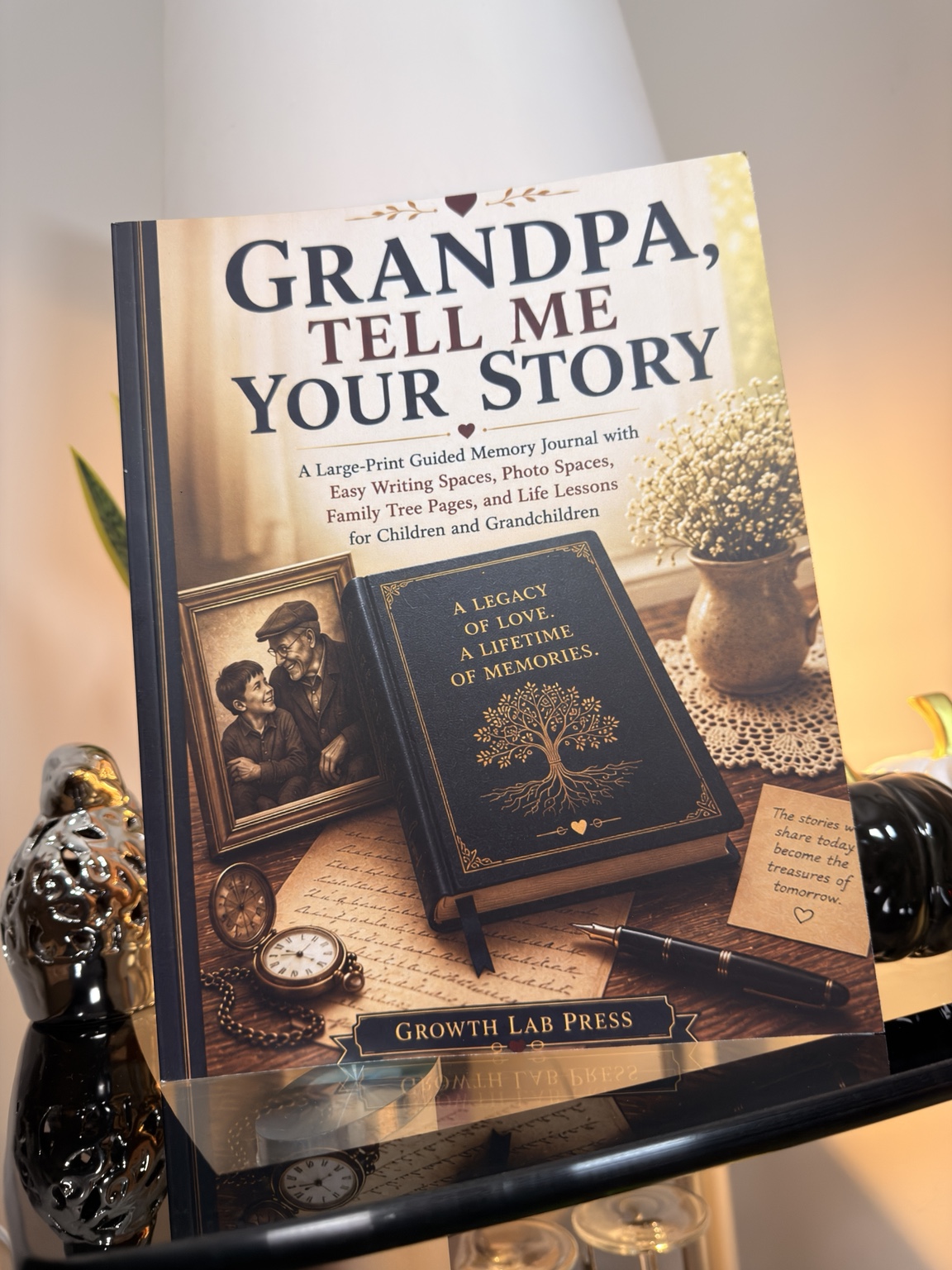
Grandma, Tell Me Your Story by Michael Bennett is a large-print guided memory journal with 531 questions, photo spaces, family tree pages, recipes, life lessons and letters. Grandpa, Tell Me Your Story is a large-print guided keepsake journal for memories, milestones, family traditions and wisdom. The current product pages list paperback and hardcover formats for both books.
Use the linked product pages to inspect the real covers, photographs and current details. The 15 neighborhood questions and sketch-map activity above were created for this article and are not presented as pages taken from either journal.
Common questions
What is a good first question about a grandparent's childhood neighborhood?
Ask, 'What did you see when you stepped outside your childhood home?' It invites a concrete description without requiring an exact date.
How many neighborhood questions should I ask in one visit?
Start with two or three. Stay with an interesting answer and continue another day rather than treating all 15 questions as a checklist.
What if my grandparent cannot remember a street name?
Use the details they do remember and label uncertain names or dates as approximate. Check maps, directories, photographs or family documents later without quietly changing their account.
Should I record the neighborhood conversation?
Only with clear permission. Explain how the recording will be used and shared, let the person stop it at any time, check the file afterward and keep a backup.
Sources and further reading
Published by Growth Lab Press. Read our editorial standards.