Word games for seniors
How to Make Compound-Word Dominoes for Seniors
Make a clear 10-tile compound-word domino game for seniors, with a checked answer chain, spoken clues and easier or harder ways to play.
How compound-word dominoes work
Each paper tile has a word on the left and a word on the right. Put two tiles side by side. The right-hand word on the first tile must join the left-hand word on the next tile to make a familiar compound word. For example, a tile ending in RAIN can sit before a tile beginning with BOW because RAIN + BOW makes RAINBOW.
Merriam-Webster explains that compounds can be written as one word, with a hyphen or as separate words. This activity uses closed compounds written as single words, so every join follows the same rule. It is a new domino-style follow-up to our earlier set of 12 compound-word puzzles, linked under Sources and further reading.
This is a cooperative word game, not a speed test. Keep the tiles face up, move them as often as needed and open the answer chain whenever checking together would be more enjoyable than guessing. The game and clues below were created for this article and are not sample pages from the linked books.
Make these 10 large-print word tiles
Cut 10 rectangles from plain card or sturdy paper. Draw a vertical line down the middle of each rectangle, then copy one pair below with one entry on each side of the line. Keep START and FINISH as words on the tiles; they show which ends of the completed line belong on the outside.
Write in dark mixed-case or capital letters and leave clear space around each word. The American Printing House for the Blind publishes research-based large-print guidance covering font, colour, spacing and formatting. For a homemade set, let the player check one sample tile before you copy all 10; the most useful size is the one that person can read comfortably.
Copy the tiles in this shuffled order. Do not number them on the front, because the order is the puzzle.
- START | RAIN
- FLOWER | BOOK
- CASE | FIRE
- BOW | CUP
- BOOK | BED
- PLACE | PLAY
- PRINT | SUN
- GROUND | HAND
- CAKE | FOOT
- ROOM | FINISH
Build the compound-word domino line
Place START | RAIN at the left edge of the table. Look for a tile whose left-hand word can follow RAIN. Put that tile immediately to the right, read the new compound aloud and continue from the unused word on the right-hand side.
After every join, point to the two touching words rather than reading across the line inside one tile. The vertical divider belongs inside a tile; the meaningful compound is formed across the gap between two different tiles.
Use all 10 tiles. The final tile should end with FINISH. If the line stops early, move back to the most recent join and try a different unused tile. Because every left-hand word is different, there is one intended chain in this set.
Use these nine clues when a join is hard to find
Read the next clue only when it is wanted. Each clue describes the compound formed across one gap in the finished domino line. The clues follow the chain from START to FINISH.
- 1. An arc of colours that may appear when sunlight meets rain.
- 2. A small individual cake, often baked in a paper case.
- 3. A mark or impression made by a foot or shoe.
- 4. A tall plant with a large flower head often associated with the sun.
- 5. A piece of furniture used to hold books.
- 6. A place built for a fire inside a room.
- 7. An outdoor area equipped for children's play.
- 8. A small reference book or practical guide.
- 9. A room used for sleeping.
Show answers or guidance
The intended clue answers are 1. RAINBOW, 2. CUPCAKE, 3. FOOTPRINT, 4. SUNFLOWER, 5. BOOKCASE, 6. FIREPLACE, 7. PLAYGROUND, 8. HANDBOOK and 9. BEDROOM.
Check the complete domino answer chain
The full left-to-right order appears below. Read each touching pair across the arrow: the word on the right of one tile joins the word on the left of the next tile.
Nine joins are formed by 10 tiles. START and FINISH are boundary labels only; they are not part of a compound word.
- START | RAIN → BOW | CUP = RAINBOW
- BOW | CUP → CAKE | FOOT = CUPCAKE
- CAKE | FOOT → PRINT | SUN = FOOTPRINT
- PRINT | SUN → FLOWER | BOOK = SUNFLOWER
- FLOWER | BOOK → CASE | FIRE = BOOKCASE
- CASE | FIRE → PLACE | PLAY = FIREPLACE
- PLACE | PLAY → GROUND | HAND = PLAYGROUND
- GROUND | HAND → BOOK | BED = HANDBOOK
- BOOK | BED → ROOM | FINISH = BEDROOM
Show answers or guidance
Finished tile order: START | RAIN, BOW | CUP, CAKE | FOOT, PRINT | SUN, FLOWER | BOOK, CASE | FIRE, PLACE | PLAY, GROUND | HAND, BOOK | BED, ROOM | FINISH. All nine joins form the listed single-word compounds.
Play a spoken version without cutting cards
Read one ending and offer two possible beginnings for the next tile. Try: 'RAIN can join BOW or CUP. Which makes a familiar word?' After the answer RAINBOW, continue: 'CUP can join CAKE or PRINT.'
The two-choice route is RAIN with BOW, CUP with CAKE, FOOT with PRINT, SUN with FLOWER, BOOK with CASE, FIRE with PLACE, PLAY with GROUND, HAND with BOOK, and BED with ROOM. Repeat either choice and say the completed word as often as useful.
Take turns choosing the correct half or inventing a clue. A participant can answer aloud, point to one of two written words or simply listen while a partner builds the chain. No writing, score or timer is required.
Show answers or guidance
Spoken answers in order: RAINBOW, CUPCAKE, FOOTPRINT, SUNFLOWER, BOOKCASE, FIREPLACE, PLAYGROUND, HANDBOOK, BEDROOM.
Make the word dominoes easier or more challenging
For an easier start, use the first four tiles in their correct order and ask the player to read the three joins. Next, mix only BOW | CUP, CAKE | FOOT and PRINT | SUN while START | RAIN remains in place. Add the remaining tiles in small groups if the player wants more.
For more challenge, cover the clue list, mix all tiles and ask the player to explain the meaning of each completed compound. Another option is to remove START and FINISH, then ask which tile logically begins and ends this particular chain.
To create a second set, choose a short list of familiar closed compounds first. Work backwards to design the tile halves, then solve the line yourself before offering it to someone else. Avoid a repeated left-hand word unless you want more than one possible branch, and keep a written answer order.
Choose prepared activity pages for more variety
Our large-print activity-book guide explains how to compare type size, contrast, spacing, instructions and answer sections. Our memory-activity-book guide helps families and caregivers consider the reader's interests, preferred activity style, support level and setting.
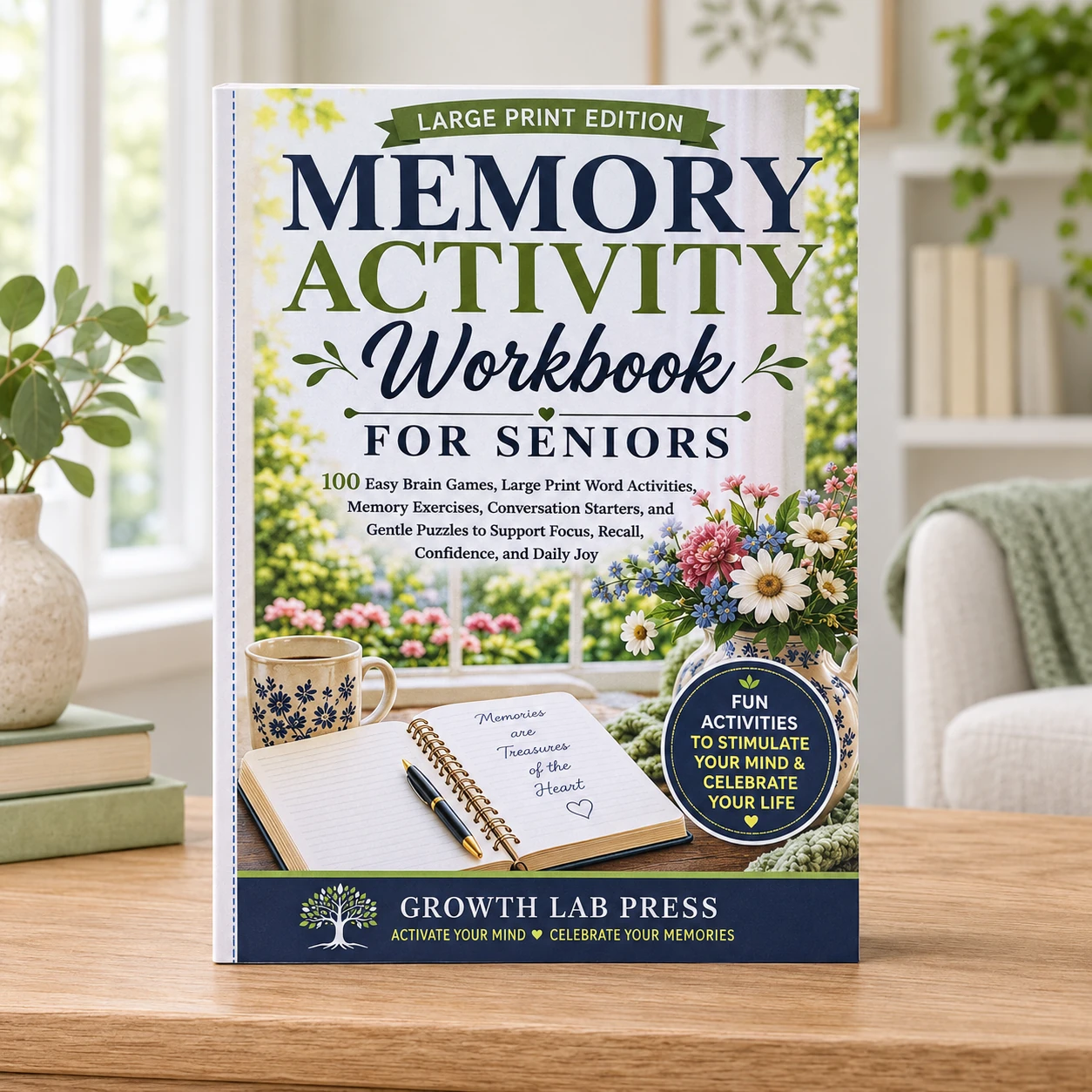
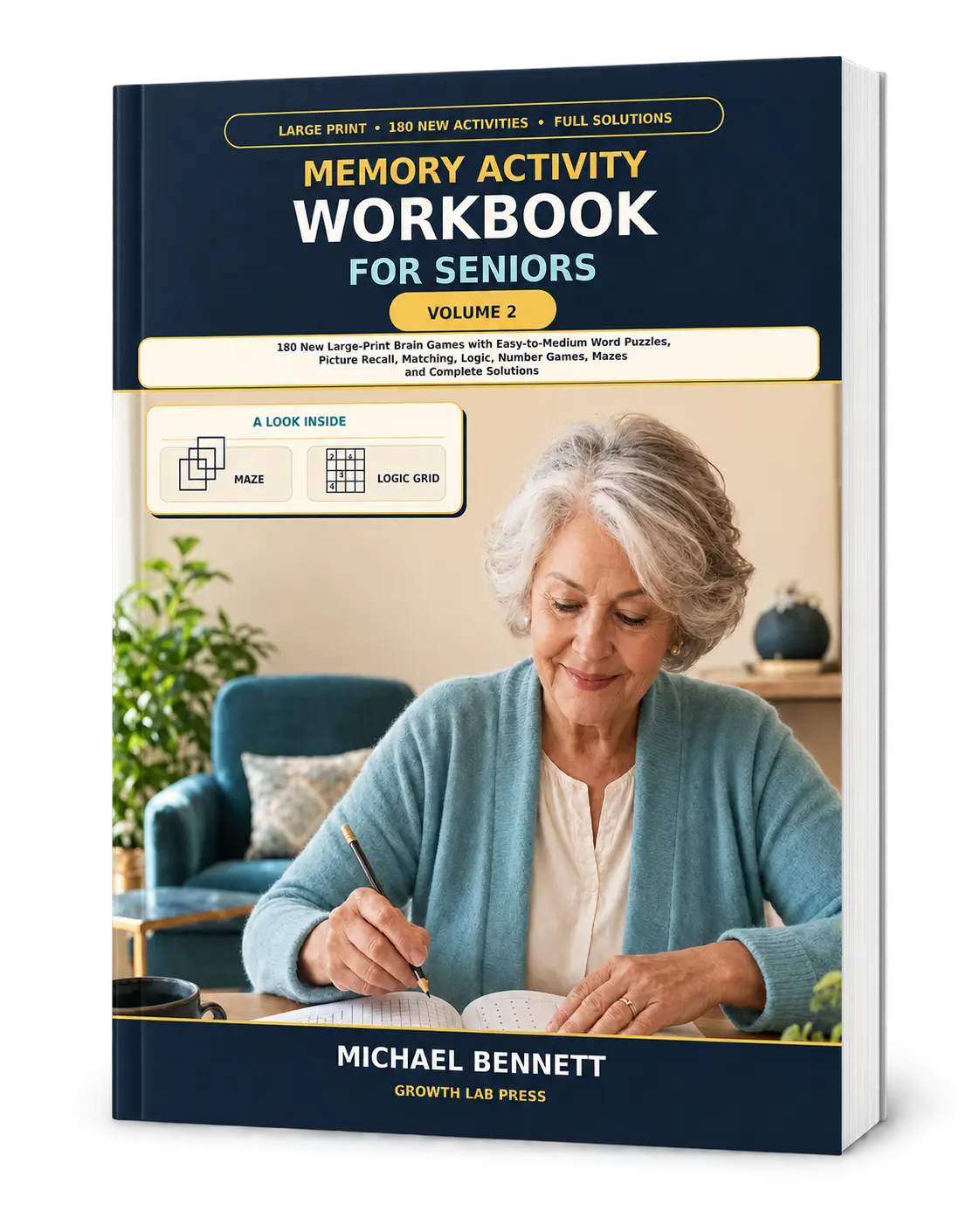
Memory Activity Workbook for Seniors by Michael Bennett is a large-print paperback with memory recall activities, word games and trivia, everyday prompts, conversation starters, reflection pages and spacious writing pages. Memory Activity Workbook for Seniors, Volume 2 contains 180 large-print word, number, matching, visual, logic, planning and maze activities in 12 chapters, with an easy-to-medium progression and complete solutions; its current product page lists paperback and hardcover formats.
Use the linked book pages to view the real covers, photographs and current product details before choosing. The compound-word dominoes in this article are an original free activity, not a description of a specific page inside either workbook and not a promise of a health outcome.
Common questions
What are compound-word dominoes?
They are paper tiles arranged in a line so the touching words on neighbouring tiles form compounds. In this set, RAIN beside BOW makes RAINBOW, then CUP beside CAKE makes CUPCAKE.
How many tiles are in this compound-word game?
There are 10 tiles and nine compound-word joins. START and FINISH mark the two outside ends of the completed line.
Can the game be played without cutting out tiles?
Yes. Read one word and offer two possible matches, or copy only the words onto a page. The spoken answer sequence is provided in the article.
Are these dominoes pages from the linked workbooks?
No. This tile set, its clues and its answer chain were created for this blog article. The linked product pages show the actual workbook details and available photographs.
Sources and further reading
Published by Growth Lab Press. Read our editorial standards.