Activities for seniors
8 Easy First-Letter Word Puzzles for Seniors, With Answers
Solve eight original first-letter word puzzles for seniors. Each round includes four clues, an optional hint, checked answers and tips for playing together.
How to solve a first-letter word puzzle
Solve four short clues. Write each answer on its own line, circle its first letter, then read those four letters from top to bottom. They spell a separate four-letter word. Keep the clue order unchanged.
For a small worked example, CUP, APPLE and TEAPOT begin with C, A and T. Reading the first letters gives CAT. The answers do not need to belong to the same topic.
The number after each clue tells you how many letters belong in its answer. Each round also has an optional hint for the final word. Cover the hint for more challenge, and open the answer panel only when you want to check.
Puzzle 1: Find the four-letter word
Optional final-word hint: a place to live.
- 1. Something worn on the head, often with a brim. (3 letters)
- 2. The kitchen appliance used to bake a loaf. (4 letters)
- 3. A drinking cup with a handle, rhyming with rug. (3 letters)
- 4. An item with a shell, cracked to make an omelette. (3 letters)
Show answers or guidance
Clue answers, in order: HAT, OVEN, MUG, EGG. First letters: H + O + M + E = HOME.
Puzzle 2: Find the four-letter word
Optional final-word hint: a sweet food often served at a birthday party.
- 1. A hair tool with a row of teeth. (4 letters)
- 2. A protective garment tied over clothes while cooking. (5 letters)
- 3. A small metal object turned inside a lock. (3 letters)
- 4. A paper container sealed around a letter for posting. (8 letters)
Show answers or guidance
Clue answers, in order: COMB, APRON, KEY, ENVELOPE. First letters: C + A + K + E = CAKE.
Puzzle 3: Find the four-letter word
Optional final-word hint: an outdoor place with paths, grass or benches.
- 1. A soft support placed under your head in bed. (6 letters)
- 2. The fruit in the familiar phrase: an ___ a day. (5 letters)
- 3. A straight tool marked with lengths for measuring. (5 letters)
- 4. An object flown in the wind at the end of a string. (4 letters)
Show answers or guidance
Clue answers, in order: PILLOW, APPLE, RULER, KITE. First letters: P + A + R + K = PARK.
Puzzle 4: Find the four-letter word
Optional final-word hint: something to read.
- 1. A metal object which rings when struck. (4 letters)
- 2. A citrus fruit whose name is also a colour. (6 letters)
- 3. A vegetable with a layered bulb, often sliced into rings. (5 letters)
- 4. A vessel with a spout, used to boil water for tea. (6 letters)
Show answers or guidance
Clue answers, in order: BELL, ORANGE, ONION, KETTLE. First letters: B + O + O + K = BOOK.
Puzzle 5: Find the four-letter word
Optional final-word hint: an animal with feathers.
- 1. A painting tool with a handle and bristles. (5 letters)
- 2. A household appliance used to press wrinkles out of clothes. (4 letters)
- 3. A narrow strip of decorative fabric tied around a gift. (6 letters)
- 4. A movable panel opened to enter a room. (4 letters)
Show answers or guidance
Clue answers, in order: BRUSH, IRON, RIBBON, DOOR. First letters: B + I + R + D = BIRD.
Puzzle 6: Find the four-letter word
Optional final-word hint: a kind of wet weather.
- 1. A device for listening to broadcast programmes. (5 letters)
- 2. A heavy object lowered to the seabed to hold a boat in place. (6 letters)
- 3. The liquid used inside a fountain pen. (3 letters)
- 4. A slim sewing tool with an eye for thread. (6 letters)
Show answers or guidance
Clue answers, in order: RADIO, ANCHOR, INK, NEEDLE. First letters: R + A + I + N = RAIN.
Puzzle 7: Find the four-letter word
Optional final-word hint: a shape often drawn with five points.
- 1. A utensil used for eating soup. (5 letters)
- 2. A cloth used for drying hands. (5 letters)
- 3. A book used to arrange and keep photographs. (5 letters)
- 4. A thick cord used for tying or pulling. (4 letters)
Show answers or guidance
Clue answers, in order: SPOON, TOWEL, ALBUM, ROPE. First letters: S + T + A + R = STAR.
Puzzle 8: Find the four-letter word
Optional final-word hint: a light often placed on a bedside table.
- 1. Portable climbing equipment with rungs. (6 letters)
- 2. The warning sound a clock makes to wake you. (5 letters)
- 3. A glass surface used to see your reflection. (6 letters)
- 4. A flat dish used for serving dinner. (5 letters)
Show answers or guidance
Clue answers, in order: LADDER, ALARM, MIRROR, PLATE. First letters: L + A + M + P = LAMP.
Make the two steps easier or more challenging
This format has two tasks: finding the clue answers and combining their first letters. Keep both visible. If a reader prefers to focus on one task, supply the four answers and invite them to find the final word.
For example, offer BRUSH, IRON, RIBBON and DOOR from Puzzle 5. Circle B together, then let the reader continue. For a spoken version, read one clue at a time and write the answer down for everyone to see. Repeat the collected letters when requested.
If a clue brings a different sensible answer, acknowledge it. Check the stated letter count and the final-word hint together. The key shows the intended route, rather than every possible interpretation of a clue.
- One small hint: give the first letter of an unsolved clue answer.
- More support: offer two words to choose between, such as COMB or BRUSH for the hair-tool clue.
- More challenge: hide the final-word hint, then solve the four clues.
- Shared play: take turns solving clues and work out the final word together. Skip scoring unless everyone wants it.
Prepare a readable paper or screen version
Copy one round onto a page with a separate line for each answer. Put four blank spaces underneath for the final word. Keep the answer key on another page so it does not reveal the solution.
RNIB describes large print as generally 16 to 18 point, with larger sizes described as giant print. Treat this as a starting reference, then ask the reader to try one sample clue before preparing the rest. Enlarge the text further if preferred. The RNIB guide is linked under Sources and further reading.
For your homemade sheet, use plain dark text on white paper and leave room beside each answer to circle its first letter. On a screen, enlarge the page and keep the answer panel closed. Start with one round and let the reader choose whether to continue.
Choose a workbook for more activity variety
These eight puzzles are original activities written for this blog. They are not sample pages from either linked workbook, and they do not establish which puzzle types appear inside those books.
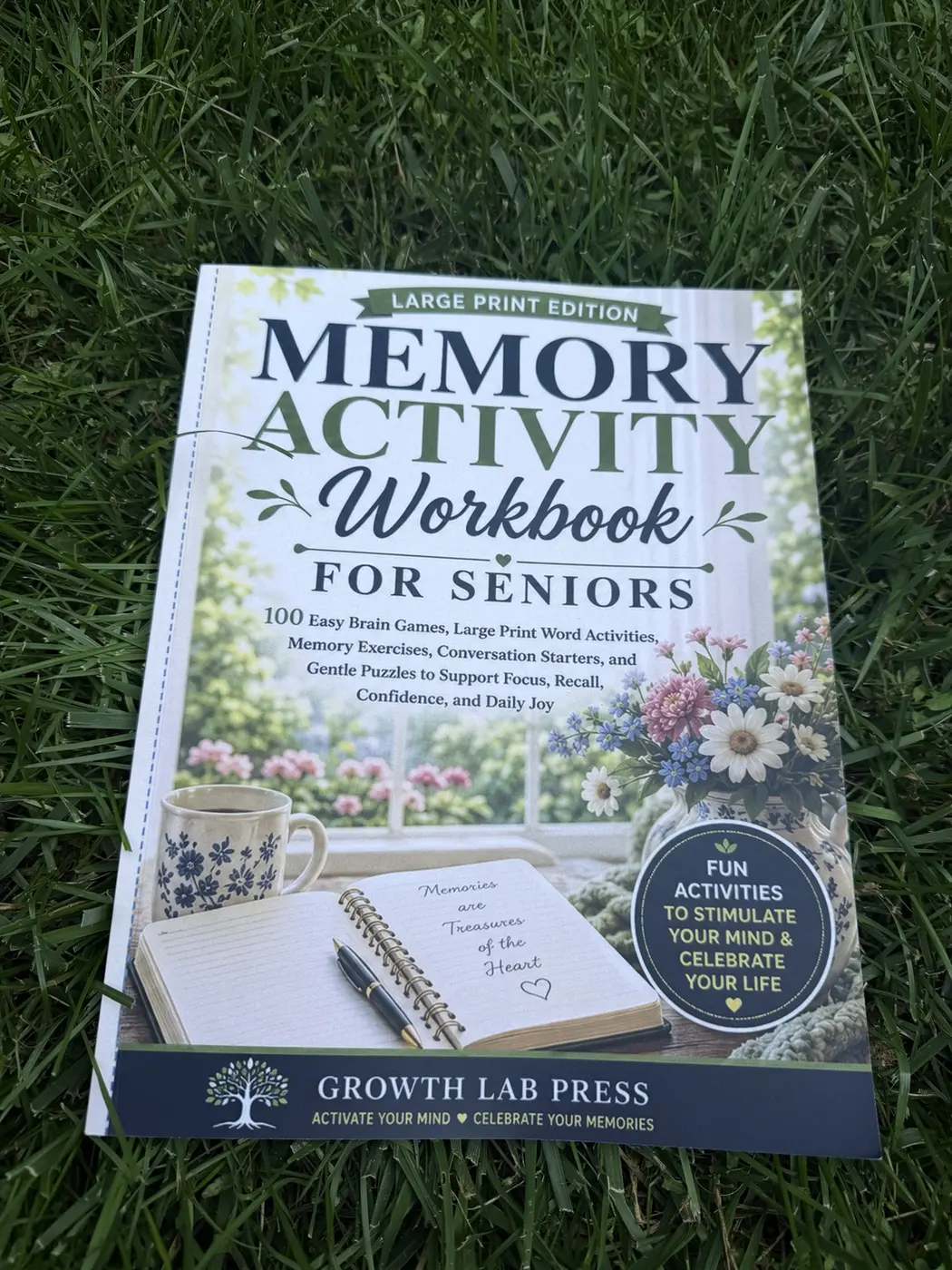
Memory Activity Workbook for Seniors includes word games, memory recall activities, conversation starters and reflection pages. Its product page shows real sample pages for checking the instructions and writing space.
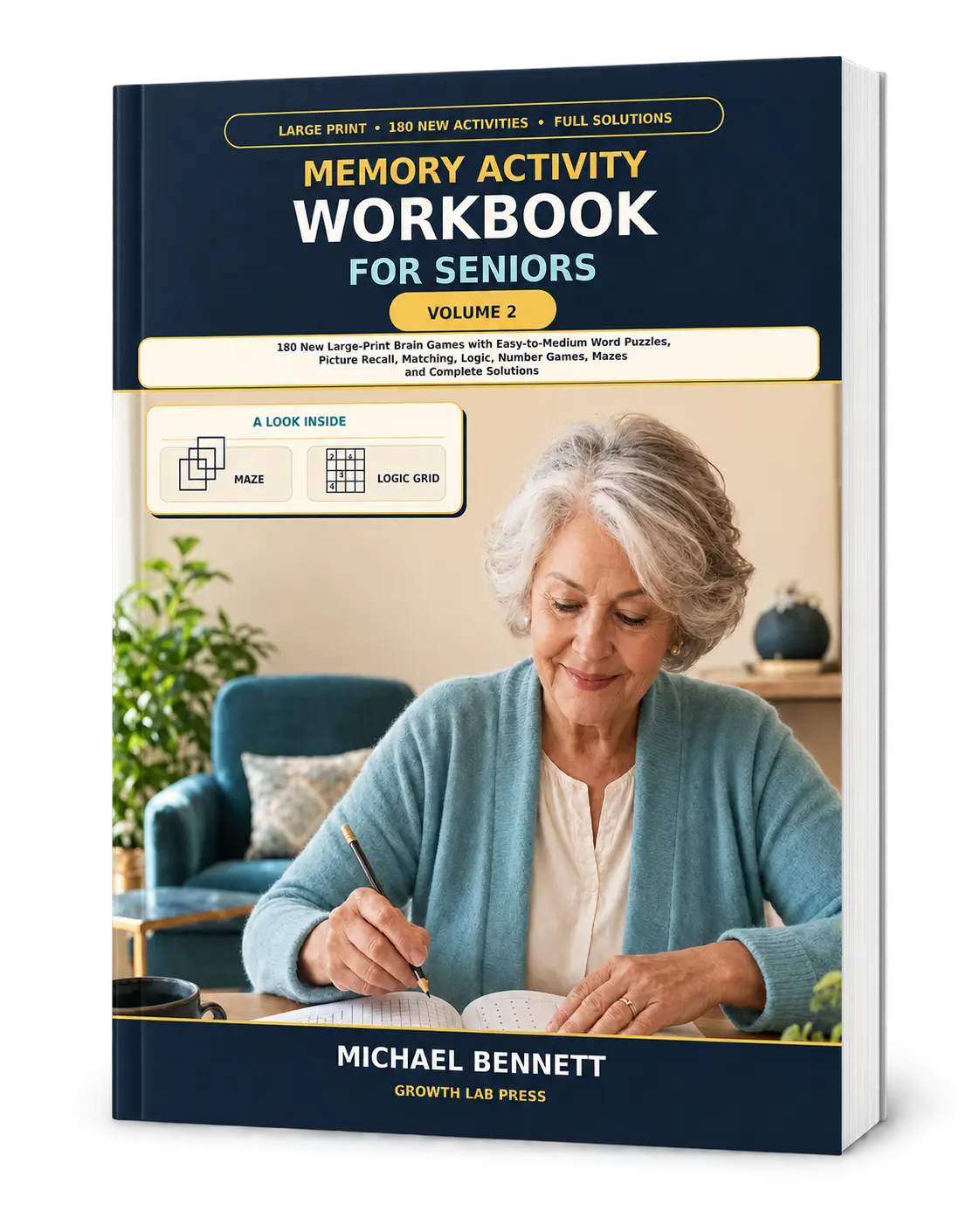
Memory Activity Workbook for Seniors, Volume 2 offers 180 large-print word, number, matching, visual, logic, planning and maze activities, with complete solutions. Compare the two linked product pages and choose the activity mix the reader enjoys.
The related guides explain how to compare print, page layout and activity choices before buying. Use the puzzles here for recreation at your own pace.
Common questions
Do these puzzles need a crossword grid?
No. Four lines for the clue answers and four spaces for the final word are enough. Read the first letters in clue order, from top to bottom.
How do we play without writing?
One person reads the clues and keeps a visible list of the answers. The other player answers aloud. Then read the first letters together, or supply the four answer words and focus only on finding the final word.
What if a different word fits a clue?
Check its letter count, then try its first letter in the final word. If it leads elsewhere, use the optional hint or reveal one answer. Treat a reasonable alternative as a useful discussion, and explain the intended answer without turning it into a score dispute.
Are these puzzles taken from a Growth Lab Press book?
No. They were created for this article. Use the linked product pages to check the actual features and available sample pages of each workbook.
Sources and further reading
Published by Growth Lab Press. Read our editorial standards.