Word games
15 Easy Category Word Puzzles for Seniors, With Answers
Try 15 easy category word puzzles for seniors, with checked sample answers, simple spoken-play rules and ways to make each prompt easier or harder.
How to play a category word game
Read one prompt and name three words that fit. For example, the prompt Name three fruits beginning with P can be answered with pear, peach and plum. A different accurate answer is equally welcome.
Play aloud, write the answers or take turns with a partner. There is no need for a timer. Give the player time to think, and offer the category again before giving a hint.
The answers below are checked examples, not the only possible solutions. That open-ended format makes a category game useful for conversation: after an answer, ask which item is a favourite, where it is found or what memory it brings to mind.
- Choose one prompt at a time
- Ask for one, two or three words
- Accept every answer that genuinely fits
- Use hints only when they are wanted
- Skip a prompt that is not enjoyable
Puzzles 1–3: Food and the kitchen
Start with familiar, concrete subjects. Read the rule exactly as written and allow alternatives that meet it.
- 1. Name three fruits that begin with P.
- 2. Name three things found in a kitchen that begin with C.
- 3. Name three foods whose English names end with the letter E.
Show answers or guidance
Sample answers: 1. pear, peach, plum. 2. cup, colander, cutting board. 3. apple, cheese, pie. Each answer fits its category and letter rule; other accurate answers also count.
Puzzles 4–6: Garden and outdoors
These prompts can lead naturally into talk about gardening, parks or seasons. The conversation can continue even after three answers are found.
- 4. Name three garden things that begin with R.
- 5. Name three things found at a park that begin with B.
- 6. Name three weather words that begin with S.
Show answers or guidance
Sample answers: 4. rose, rake, radish. 5. bench, bird, ball. 6. sun, snow, storm.
Puzzles 7–9: Animals, clothes and travel
If a first-letter rule feels difficult, remove it and keep only the category. Name three animals is still a complete activity.
- 7. Name three animals that begin with B.
- 8. Name three items of clothing that begin with S.
- 9. Name three things connected with travel that begin with T.
Show answers or guidance
Sample answers: 7. bear, beaver, butterfly. 8. shirt, socks, scarf. 9. train, ticket, taxi.
Puzzles 10–12: Home, music and mail
The next three prompts use broad everyday categories without requiring every answer to share a first letter.
- 10. Name three rooms commonly found in a home.
- 11. Name three things connected with music that begin with P.
- 12. Name three things connected with sending a letter.
Show answers or guidance
Sample answers: 10. kitchen, bedroom, bathroom. 11. piano, performer, playlist. 12. stamp, envelope, address.
Puzzles 13–15: Colour, shape and a garden shed
Finish with categories that invite visual imagination. If an answer could vary by colour or design, ask the player to explain it rather than rejecting it.
- 13. Name three things that are often red.
- 14. Name three things that are round.
- 15. Name three items often kept in a garden shed.
Show answers or guidance
Sample answers: 13. tomato, stop sign, strawberry. 14. coin, plate, wheel. 15. shovel, gardening gloves, watering can.
Four ways to make a category puzzle easier
Adjust the prompt before assuming the person does not enjoy word games. A first-letter rule adds difficulty, so the easiest change is to remove it. You can also ask for one answer instead of three.
For a person living with dementia, the Alzheimer's Association recommends matching activities to current abilities, using simple steps, focusing on enjoyment rather than achievement and changing or ending an activity when frustration appears. The National Institute on Aging likewise advises choosing activities the person enjoys, helping them begin and watching for frustration.
These are recreational prompts, not a memory test or treatment. A wrong answer does not need correction unless the player asks. Keep the tone adult, respectful and relaxed.
- Remove the first-letter rule: Name any three fruits
- Ask for one word instead of three
- Offer two choices: Is a rake or a radio more likely to be in a shed?
- Give the first answer and invite the next one
Four ways to add challenge without adding pressure
Ask first whether the player wants a harder round. Challenge should be an invitation, not a surprise rule introduced after someone answers.
A timer is optional and may make a pleasant activity feel like a performance. A better first step is to ask for a fourth word or switch to a less common starting letter.
- Ask for four or five words
- Use a new first letter with the same category
- Find two answers that begin with consecutive letters
- Create a new category prompt for the other player
Use the puzzles in a family visit or small group
In a group, read one prompt and move around the circle for one answer per person. Do not eliminate anyone. If a player repeats a word, accept it or gently ask whether they would like another turn.
Write accepted answers where everyone can see them, or keep the whole game spoken. After three answers, use one short follow-up such as Which of these would you choose? or Does one remind you of home? Then move to a new category while the energy is good.
For a family visit, let the older adult choose between two subjects, such as food or outdoors. Choice keeps the game collaborative and often reveals which topics are most enjoyable that day.
Create new category prompts in one minute
Choose an adult, familiar subject such as tools, music, travel, cooking, work, clothing, garden plants or local places. Add one clear rule: a starting letter, an ending letter, a colour, a shape or a place where the item is found.
Before using the prompt, write at least three sample answers yourself. If you cannot find three without stretching the meaning of the category, change the letter or broaden the subject.
Good example: Name three tools that begin with H. Checked sample answers are hammer, handsaw and hatchet. Weak example: Name three musical instruments that begin with X. A puzzle should invite participation, not depend on obscure vocabulary.
Continue with a large-print activity workbook
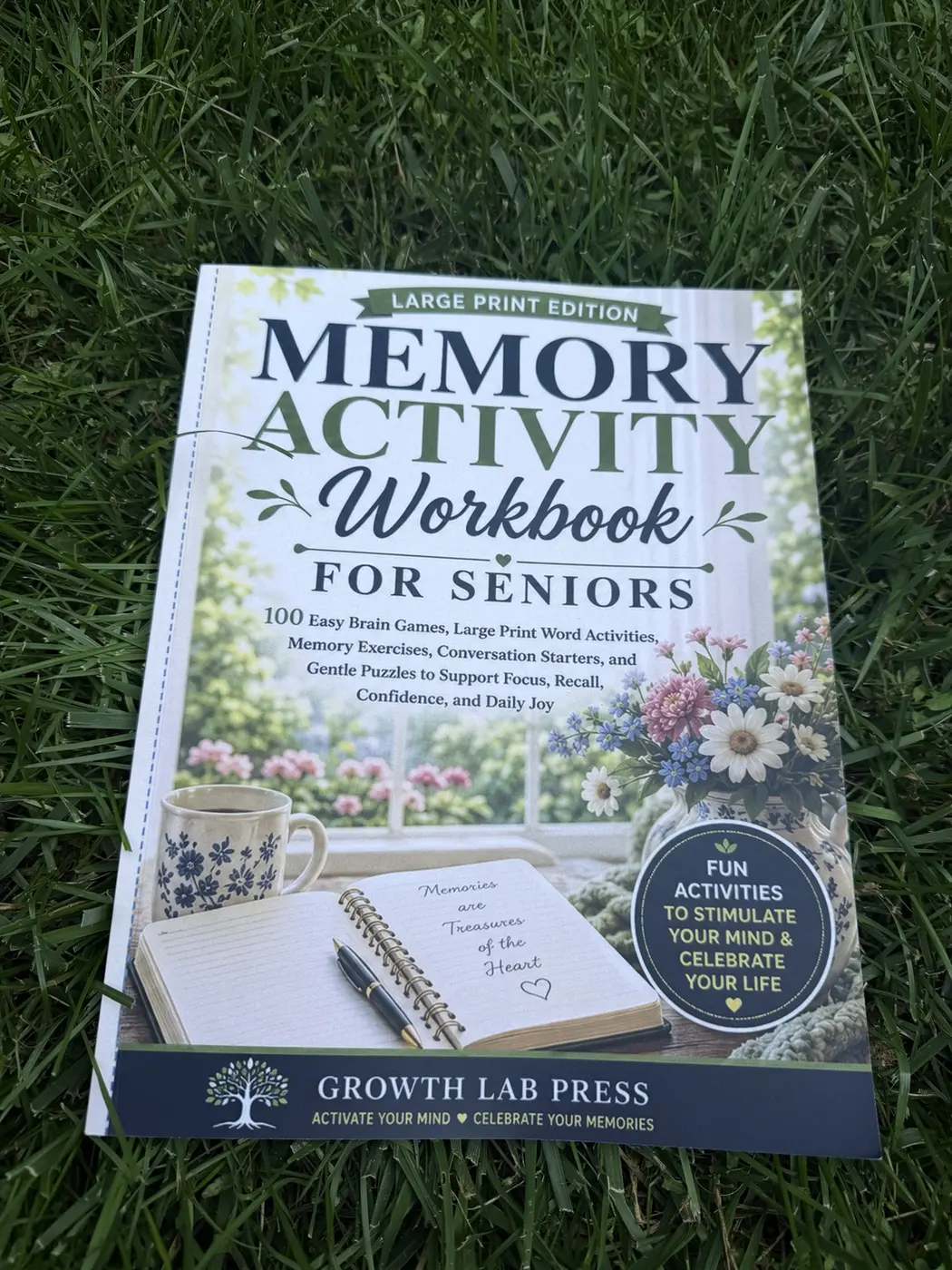
Memory Activity Workbook for Seniors includes large-print word activities, category challenges, missing-letter puzzles, memory prompts, conversation starters and reflection pages. It is a paperback written by Michael Bennett for older adults, caregivers and families.
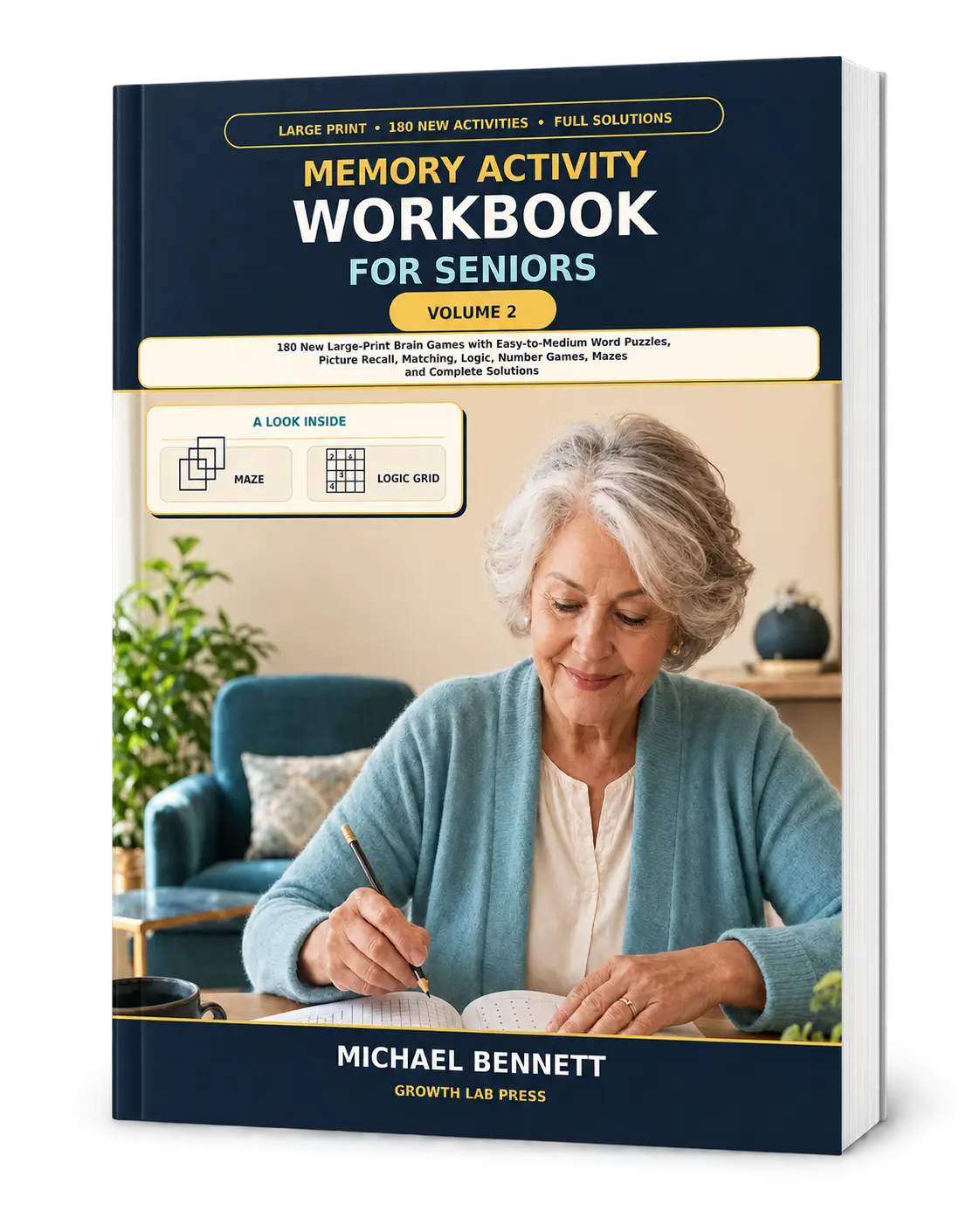
Memory Activity Workbook for Seniors, Volume 2 contains 180 large-print word, number, matching, visual, logic, planning and maze activities in 12 chapters, with an easy-to-medium progression and complete solutions. It is available in paperback and hardcover.
The related large-print guide explains what to check for readability, spacing and activity fit. The book-selection guide helps match activity style and support needs to the person and setting. The 15 category puzzles in this article were created for this page and are not sample pages from either workbook.
Common questions
What is a category word game for seniors?
It is a word activity in which a player names items that fit a subject and sometimes an extra rule, such as three fruits beginning with P. It can be played aloud or in writing.
Do category word puzzles have only one correct answer?
Usually not. The answers in this article are checked examples. Any word that genuinely fits the category and rule should count.
How can I make a category word game easier?
Remove the first-letter rule, ask for one answer, offer two choices or provide the first example. Stop or change the activity if it is not enjoyable.
Can category word games be played without writing?
Yes. Read one prompt aloud and take turns giving answers. A partner can keep a list if the group wants to see the words.
Sources and further reading
Published by Growth Lab Press. Read our editorial standards.