Word games for seniors
15 Easy Hidden Word Puzzles for Seniors, With Answers
Try 15 easy hidden word puzzles for seniors with clear clues, checked answers and simple ways to play aloud, on paper or with a small group.
How to play a hidden word puzzle
Look at the longer word and find the shorter answer hidden inside it. The answer's letters must sit next to one another, from left to right, without being rearranged.
For example, TEAPOT hides TEA. The letters T-E-A appear together at the beginning of the longer word. A clue beside each puzzle tells you what kind of word to find.
Start with three to five puzzles and ask whether the player wants more. Use the activity for recreation, not as a memory test, and do not add a timer unless the player specifically enjoys timed games.
- Keep the hidden letters together
- Read from left to right
- Do not rearrange the letters
- Use the clue whenever helpful
- Accept a pause, hint or pass
Set up a comfortable puzzle round
Print or write one longer word per line in dark, clear letters. Leave generous space between puzzles and keep the answer key on a separate page. If the player prefers not to write, read the clue aloud and let them say or point to the hidden word.
The National Institute on Aging recommends matching activities to what a person can do, helping them get started and watching for frustration. The Alzheimer's Association advises focusing on enjoyment rather than achievement and adjusting activities to a person's interests and abilities.
These puzzles are not a treatment or assessment for dementia or memory loss. Individual preferences can change from day to day, so make the round shorter, easier or entirely conversational when that feels better.
Puzzles 1–5: Hidden words at the beginning or end
The first five answers sit at the beginning or end of each longer word. Show the example TEAPOT → TEA before starting if the format is new.
- 1. CARPET — Find a road vehicle.
- 2. NOTEBOOK — Find something you can read.
- 3. SHOEBOX — Find a container.
- 4. RAINCOAT — Find water that falls from clouds.
- 5. SUNFLOWER — Find a garden bloom.
Puzzles 6–10: Hidden words in the middle
These answers sit inside the longer word rather than at an obvious edge. Read the clue first if the player would like an easier round.
- 6. MARKET — Find a large boat from a familiar story.
- 7. CHAIR — Find what people breathe.
- 8. PLANTER — Find a tiny insect.
- 9. KITCHEN — Find a female chicken.
- 10. GARDEN — Find an animal's sheltered home.
Puzzles 11–15: A mixed final round
The last five mix beginning, middle and ending positions. Give a position hint such as near the start or near the end only when requested.
- 11. BASKET — Find a word meaning to request information.
- 12. PLANET — Find a narrow part of a road.
- 13. PILLOW — Find a word meaning not well.
- 14. WATERING — Find a circular piece of jewellery.
- 15. BREAKFAST — Find a word meaning not slow.
Check all 15 hidden word answers
Every answer appears as one unbroken, left-to-right sequence inside its longer word. The capital letters below show the hidden section.
- 1. CARpet → CAR
- 2. noteBOOK → BOOK
- 3. shoeBOX → BOX
- 4. RAINcoat → RAIN
- 5. sunFLOWER → FLOWER
- 6. mARKet → ARK
- 7. chAIR → AIR
- 8. plANTer → ANT
- 9. kitcHEN → HEN
- 10. garDEN → DEN
- 11. bASKet → ASK
- 12. pLANEt → LANE
- 13. pILLow → ILL
- 14. wateRING → RING
- 15. breakFAST → FAST
Show answers or guidance
The complete answer key is CAR, BOOK, BOX, RAIN, FLOWER, ARK, AIR, ANT, HEN, DEN, ASK, LANE, ILL, RING and FAST. Each answer is contained exactly within its longer word.
Make hidden word puzzles easier
Reveal the answer length by drawing one blank for each letter. You can also underline the part of the longer word where the answer begins or give a choice between two possible answers.
For BASKET, write three blanks and say: The answer means to request information. If another hint is needed, underline ASK without reading it aloud.
Use letter cards when pointing at printed words is difficult. Write one letter on each card, place the longer word in order and let the player slide the hidden group forward.
- Show how many letters are in the answer
- Underline the area containing the answer
- Offer two possible answers
- Say the first answer letter
- Use movable letter cards
Add challenge without adding pressure
Hide the clue at first and reveal it only after one attempt. Another option is to ask where the word appears: beginning, middle or end. A confident player can try to find two shorter words in a longer word when more than one sensible answer exists.
For example, RAINCOAT includes RAIN and COAT. NOTEBOOK includes NOTE and BOOK. Let the player explain both answers rather than treating only one as correct.
Do not assume that harder is better. The right level is the one the player chooses and enjoys.
Play aloud, with a partner or in a group
For play without writing, show one word in large print while a partner reads the clue. The player can say the answer, spell it or point to its first letter. A partner may trace under the letters only when asked.
With a small group, solve as one team. Invite answers to the room instead of requiring turns around a circle. Someone may read clues, hold cards, check answers or simply listen.
After an answer, add an optional conversation prompt. RAIN might lead to favourite rainy-day activities; FLOWER could open a discussion about gardens; BOOK might invite the group to name a story they enjoyed. Set the puzzle aside when the conversation becomes the better activity.
Create a new hidden word puzzle
Choose a familiar short word, then look for a longer everyday word that contains it without changing the letter order. Check the spelling carefully and write a clue that points only to the shorter answer.
A simple template is: Longer word — Find a word meaning ___. Try NOTEBOOK for NOTE, CUPBOARD for CUP or WATERING for RING. Keep the answer key separate so another person can lead the activity.
Avoid obscure words and clues with several equally likely answers unless you plan to accept all sensible solutions.
Continue with large-print activity books
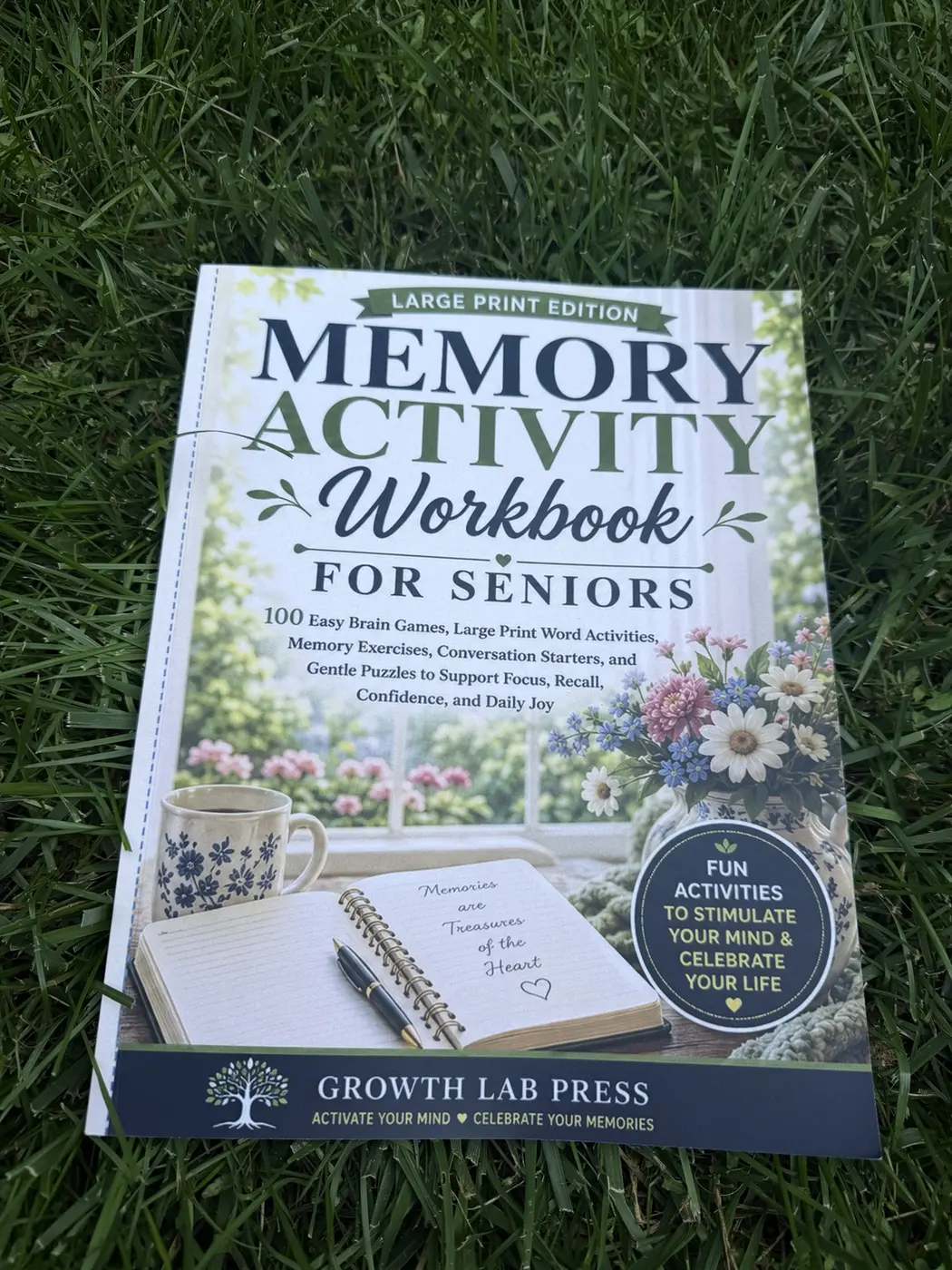
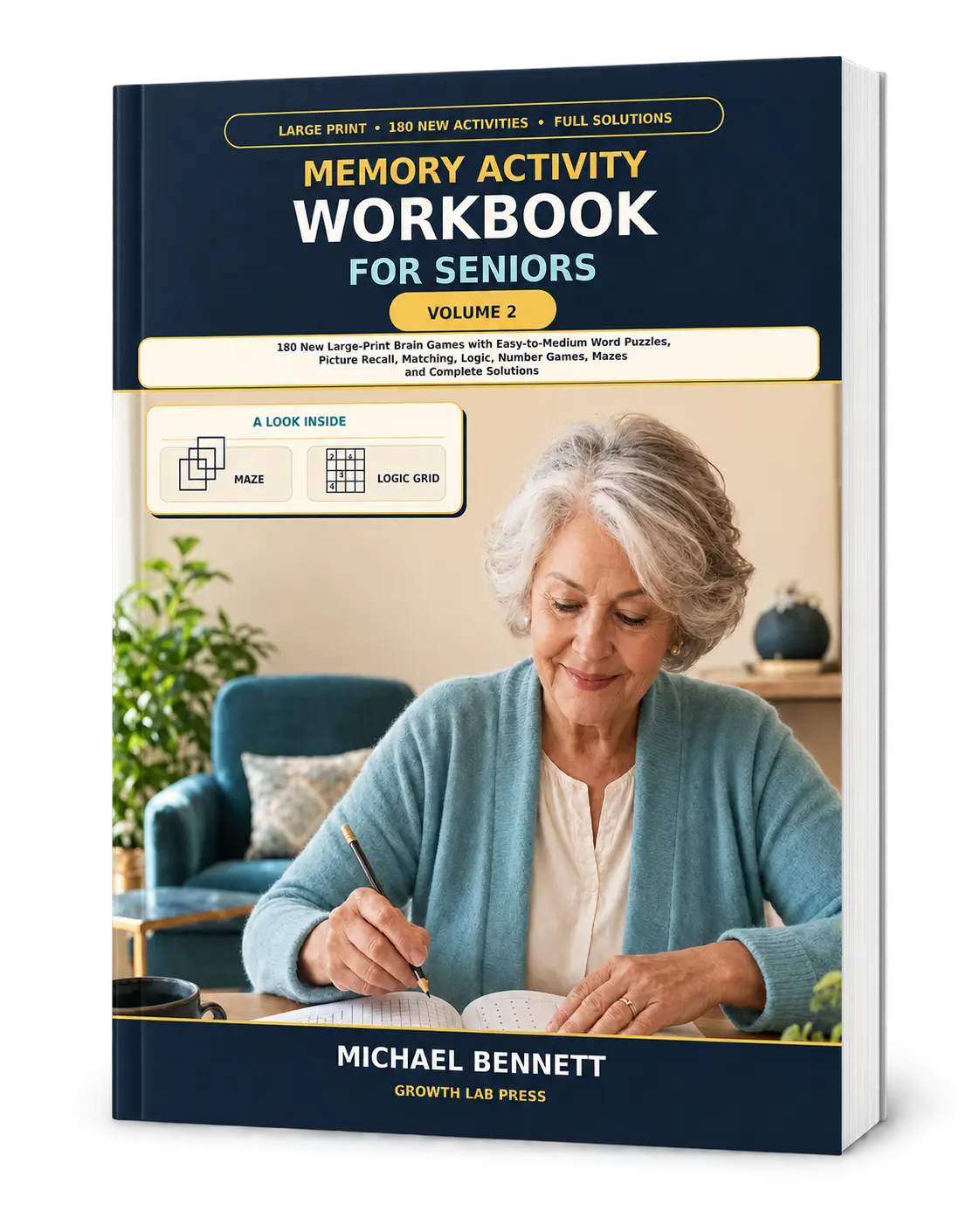
Memory Activity Workbook for Seniors is a large-print paperback with memory recall activities, word games and trivia, everyday prompts, conversation starters, reflection pages and spacious writing pages. Memory Activity Workbook for Seniors, Volume 2 contains 180 large-print word, number, matching, visual, logic, planning and maze activities with complete solutions. Both books are written by Michael Bennett.
The related large-print guide explains how to compare instructions, contrast, spacing and answer guidance. The book-selection guide helps families and caregivers match activity style, support level and setting to the person who will use it.
Use the product links below to review the current descriptions and formats before choosing. The 15 hidden word puzzles above are original blog activities and are not presented as pages from either workbook.
Common questions
What is an easy hidden word puzzle for seniors?
Try CARPET with the clue find a road vehicle. The answer is CAR because those three letters appear together at the beginning.
Do hidden word puzzles require rearranging letters?
No. In this puzzle format, the answer's letters stay together, from left to right, inside the longer word.
Can hidden word puzzles be played without writing?
Yes. Show one longer word in large print, read the clue aloud and let the player say, spell or point to the answer.
Do these puzzles improve memory or treat dementia?
This article makes no medical claim. Use the puzzles for recreation and shared word play, and speak with a qualified health professional about memory concerns or individual care needs.
Sources and further reading
Published by Growth Lab Press. Read our editorial standards.