Word games for seniors
15 Easy Missing-Vowel Puzzles for Seniors, With Answers
Try 15 easy missing-vowel puzzles for seniors with familiar words, clear clues, checked answers and simple options for paper, spoken or group play.
How to play a missing-vowel puzzle
Each puzzle shows a familiar word with A, E, I, O and U replaced by blank lines. Keep every consonant in its original position, use the clue and restore the missing vowels to complete the word.
For example, C _ P means something used for drinking. Add U to make CUP. In this set, Y stays visible as a consonant, so F _ M _ L Y becomes FAMILY.
Say the completed word, write the missing vowels or point to vowel cards. There is no need to time the activity, and a hint or pass is always acceptable.
- Use only A, E, I, O or U in the blanks
- Keep the visible letters in the same order
- Use one vowel for each blank
- Read the clue whenever helpful
- Check the complete word in the answer key
Set up a comfortable word-game round
Show one puzzle per line in dark, clear type and leave generous space around the blanks. Keep the answers on a separate page. If writing is uncomfortable, read the clue and let the player answer aloud or choose from five vowel cards.
The National Institute on Aging recommends matching activities to what a person can do, helping them get started and watching for frustration. The Alzheimer's Association similarly advises adapting activities to current abilities and focusing on enjoyment rather than achievement.
Use these puzzles for recreation and shared word play, not as a medical test or treatment. Start with three to five words, then continue only if the player wants another round.
Puzzles 1–5: One or two missing vowels
Begin with short, familiar words. Read each clue before showing the letter pattern if the player would like an easier start.
- 1. T _ _ P _ T — A small pot used for making and serving tea.
- 2. G _ R D _ N — A place where flowers or vegetables grow.
- 3. W _ N D _ W — A glass opening that lets light into a room.
- 4. P _ L L _ W — A soft support for your head in bed.
- 5. K _ T C H _ N — The room where meals are prepared.
Puzzles 6–10: Everyday words
The next five words are slightly longer. Point to each blank from left to right and try one vowel at a time.
- 6. F L _ W _ R — The colourful part of a plant.
- 7. M _ R K _ T — A place where people buy and sell goods.
- 8. B _ T T _ N — A small fastener on a shirt or coat.
- 9. F _ M _ L Y — Parents, children and other relatives.
- 10. C _ M _ R _ — A device used to take photographs.
Puzzles 11–15: A mixed final round
These words have several missing vowels. Offer the first vowel or say the whole word slowly when a clue alone is not enough.
- 11. B _ C Y C L _ — A two-wheeled vehicle moved by pedals.
- 12. S _ N S H _ N _ — Bright light from the sun.
- 13. _ M B R _ L L _ — Something held overhead in the rain.
- 14. T _ L _ P H _ N _ — A device used to call and speak with someone.
- 15. N _ T _ B _ _ K — A book of blank or ruled pages for notes.
Check all 15 missing-vowel answers
The answer key shows the vowels restored in order. Every blank in the puzzle lines corresponds to exactly one vowel in the completed word.
- 1. TEAPOT — E, A, O
- 2. GARDEN — A, E
- 3. WINDOW — I, O
- 4. PILLOW — I, O
- 5. KITCHEN — I, E
- 6. FLOWER — O, E
- 7. MARKET — A, E
- 8. BUTTON — U, O
- 9. FAMILY — A, I
- 10. CAMERA — A, E, A
- 11. BICYCLE — I, E
- 12. SUNSHINE — U, I, E
- 13. UMBRELLA — U, E, A
- 14. TELEPHONE — E, E, O, E
- 15. NOTEBOOK — O, E, O, O
Show answers or guidance
The complete answers are TEAPOT, GARDEN, WINDOW, PILLOW, KITCHEN, FLOWER, MARKET, BUTTON, FAMILY, CAMERA, BICYCLE, SUNSHINE, UMBRELLA, TELEPHONE and NOTEBOOK.
Make the puzzles easier or more challenging
For an easier round, say the word aloud and ask which vowel belongs in one selected blank. You can also offer two choices, such as Is the first blank in G _ R D _ N an A or an O? Fill one blank as an example before asking for the next.
For more challenge, cover the clue at first, mix words from several themes or ask the player to name the missing vowels before saying the complete word. Another option is to add a conversation prompt after the answer: GARDEN might lead to a favourite flower, while CAMERA might invite a story about a treasured photograph.
Change the level as soon as the activity stops feeling enjoyable. A completed page is not the goal; a comfortable shared activity is enough.
- Fill the first blank as a model
- Offer two vowel choices
- Say the whole word slowly
- Use movable A, E, I, O and U cards
- Hide the clue for a harder round
Play aloud, with a partner or in a small group
For play without writing, show one large-print pattern while a partner reads the clue. The player can say the word, call out each vowel or point to vowel cards. A partner can write the letters only after the player chooses them.
In a small group, solve as one team rather than requiring turns around a circle. One person can hold the prompt, another can place vowel cards and another can check the answer. Listening is also a valid way to join.
Keep the discussion that follows a word when it interests the group. The conversation may be more valuable to the visit than finishing the remaining puzzles.
Create a new missing-vowel puzzle
Choose a familiar word, write it in capital letters and replace every A, E, I, O and U with one blank. Leave Y visible for consistency with this set. Then write one short clue that points clearly to the complete word.
Check the puzzle in both directions: restore the listed vowels to confirm the original spelling, then make sure every vowel in the original word was removed. Avoid rare words and clues that could produce several equally likely answers.
A simple template is WORD, vowel-free pattern, clue and answer. For ORANGE, write _ R _ N G _ and use the clue A citrus fruit and a colour.
Continue with large-print activity books
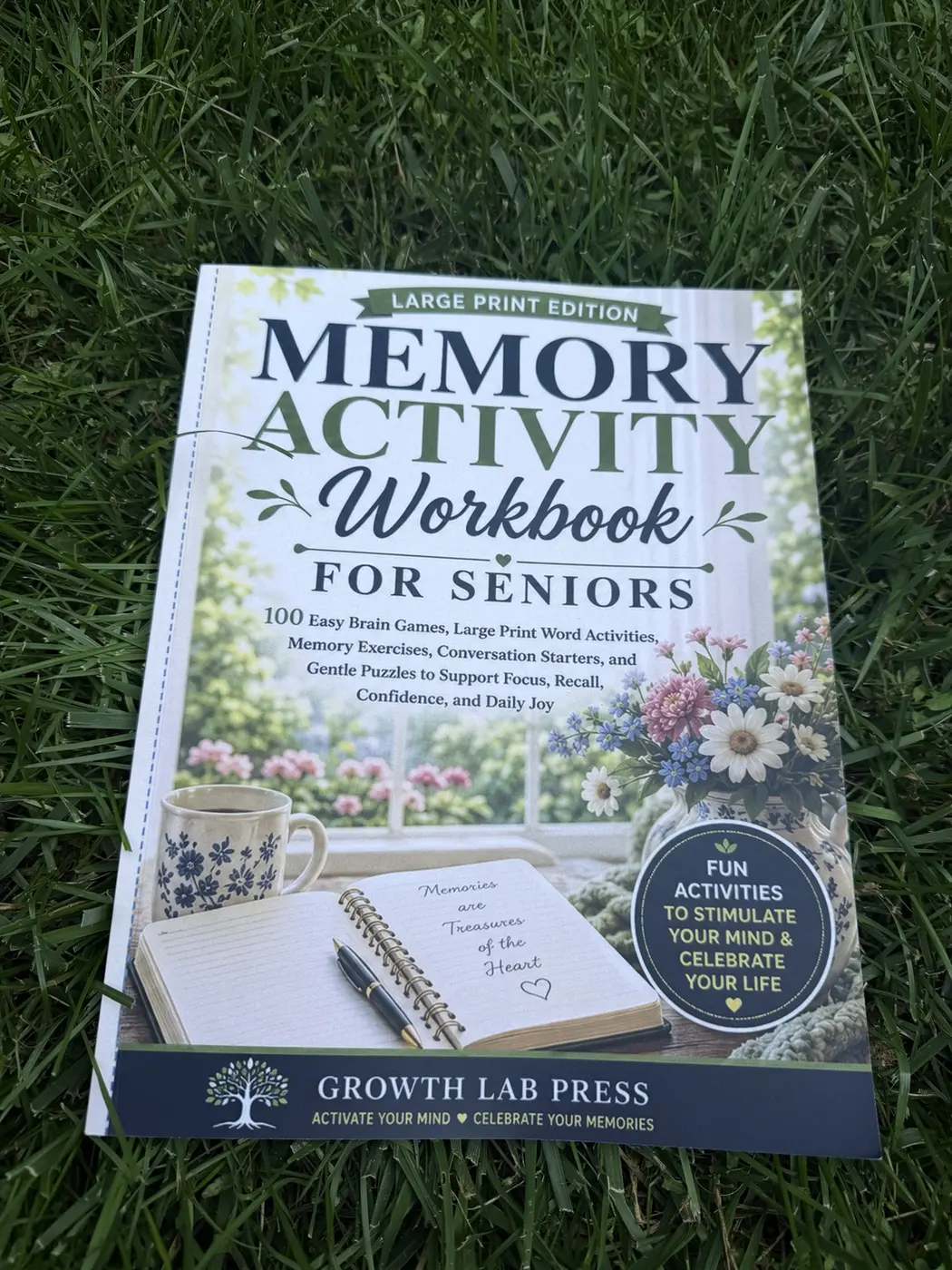
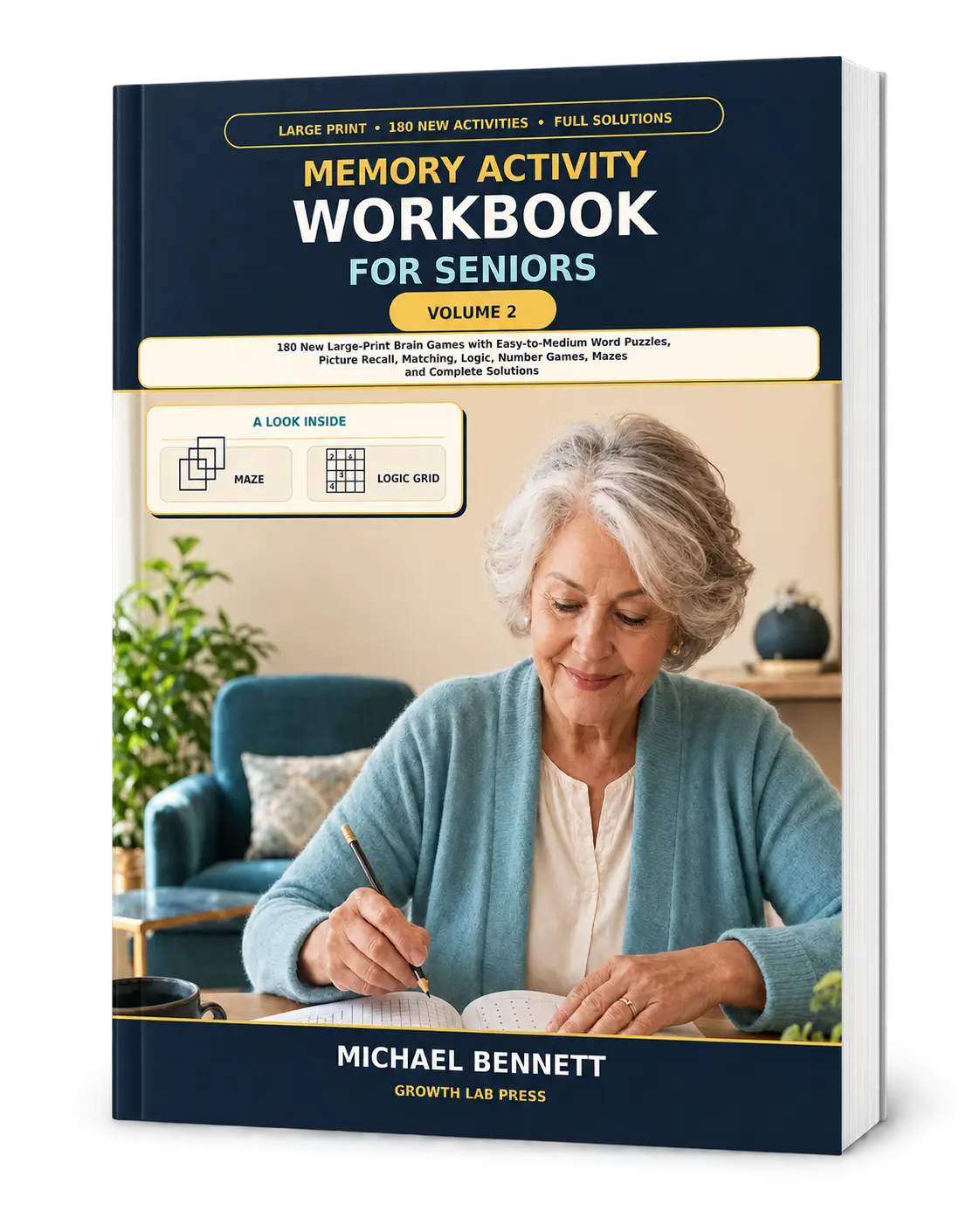
Memory Activity Workbook for Seniors is a large-print paperback with memory recall activities, word games and trivia, including missing-letter puzzles, plus everyday prompts, conversation starters, reflection pages and spacious writing pages. Memory Activity Workbook for Seniors, Volume 2 contains 180 large-print word, number, matching, visual, logic, planning and maze activities with complete solutions. Both books are written by Michael Bennett.
The related large-print guide explains how to compare instructions, contrast, spacing and answer guidance. The book-selection guide helps families and caregivers match an activity style, support level and setting to the person who will use it.
Use the product links below to review the current descriptions and formats before choosing. The 15 missing-vowel puzzles above were created for this article and are not presented as pages from either workbook.
Common questions
What is an easy missing-vowel puzzle for seniors?
Try C _ P with the clue something used for drinking. Add U to make CUP. Use one short familiar word at a time.
Does Y count as a vowel in these puzzles?
No. This set removes only A, E, I, O and U, so Y remains visible in words such as FAMILY and BICYCLE.
Can missing-vowel puzzles be played without writing?
Yes. Read the clue, show the pattern in large print and let the player say the answer or point to A, E, I, O and U cards.
Do missing-vowel puzzles improve memory or treat dementia?
This article makes no medical claim. Use the puzzles for recreation and shared word play, and speak with a qualified health professional about memory concerns or individual care needs.
Sources and further reading
Published by Growth Lab Press. Read our editorial standards.