Senior activities
How to Use a Grocery Flyer for a 20-Minute Senior Activity
Turn a grocery flyer into a flexible senior activity with a fictional large-print flyer, sorting games, word hunts and checked price puzzles.
Choose a grocery flyer that is easy to explore
Use a paper flyer, a store advertisement or the fictional one below. Choose one page with clear item names, visible prices and only a few sections. The activity does not require a shopping trip, a purchase or any food preparation.
RNIB describes large print as generally 16 to 18 point, while individual readers may prefer another size. If a real flyer is crowded or small, copy six to ten items onto plain paper in larger dark text and leave generous space between lines.
The National Institute on Aging advises matching an activity to what a person can do, helping them get started and watching for frustration. Ask whether the participant would prefer finding items, sorting categories, choosing foods, solving price questions or talking about shopping memories.
Use this fictional large-print grocery flyer
Copy the four sections below onto one sheet. The products, package sizes and prices are fictional and are provided only for the activities in this article.
- Produce — Apples, 2-lb bag, $4; Carrots, 2-lb bag, $3
- Bakery — Whole wheat bread, $3
- Dairy — Milk, 2 L, $5; Eggs, dozen, $4; Yogurt, 4-pack, $4
- Pantry — Rice, 2 kg, $6; Tomato soup, $2; Tea, 20 bags, $5
- Meat — Chicken, 1 kg, $12
Activities 1 and 2: find an item and sort by store section
Activity 1 — flyer finder: ask one question at a time. Try, 'Which pantry item costs $2?', 'Can you find the dozen eggs?' and 'Which produce item costs $3?' Let the participant point, say the answer or read the line aloud.
Activity 2 — section sort: write PRODUCE, BAKERY, DAIRY, PANTRY and MEAT on five cards. Read an item and ask where it belongs. Start with Apples, Bread, Milk, Rice and Chicken before adding the other items.
Keep the flyer visible and offer two section choices when useful. The goal is to explore the page together, not to test memory.
Show answers or guidance
Activity 1 answers: Tomato soup is the pantry item costing $2. Eggs are sold by the dozen. Carrots are the produce item costing $3. Activity 2 answers: Apples—Produce; Whole wheat bread—Bakery; Milk—Dairy; Rice—Pantry; Chicken—Meat.
Activity 3: build a short fictional shopping list
Choose three to five items from the practice flyer. The participant can point while a partner writes the list. Try a breakfast list, a soup-and-sandwich list or an imaginary list for a family picnic.
Add one simple rule if the participant wants more structure: include one item from three different sections, choose exactly four items or make a list without using Chicken. Personal choices do not have a right answer.
If real groceries, allergies, nutrition or meal plans are discussed, follow the person's preferences, care plan and professional guidance. This fictional activity does not recommend what anyone should buy or eat.
Activity 4: try six grocery price puzzles
Keep the fictional flyer visible. Allow paper, coins, counting aloud or a calculator, and read one question at a time.
- 1. What is the total for Apples and Carrots?
- 2. What is the total for Bread, Milk and Eggs?
- 3. What is the total for Rice and Tomato soup?
- 4. What is the total for Tea and Yogurt?
- 5. What is the total for Chicken, Rice and Carrots?
- 6. How much more does Chicken cost than Tomato soup?
Show answers or guidance
1. Apples $4 + Carrots $3 = $7. 2. Bread $3 + Milk $5 + Eggs $4 = $12. 3. Rice $6 + Tomato soup $2 = $8. 4. Tea $5 + Yogurt $4 = $9. 5. Chicken $12 + Rice $6 + Carrots $3 = $21. 6. Chicken $12 − Tomato soup $2 = $10.
Activity 5: play a grocery word hunt
Use the same practice flyer as a short reading and word game. Every answer remains visible on the page.
- 1. Find the two items whose names begin with T.
- 2. Find the three-letter drink.
- 3. Find all three items priced at $4.
- 4. Find the two items sold in 2-lb bags.
- 5. Find the item whose first two letters are CH.
- 6. Find the only item in the Bakery section.
Show answers or guidance
1. Tomato soup and Tea. 2. Tea. 3. Apples, Eggs and Yogurt. 4. Apples and Carrots. 5. Chicken. 6. Whole wheat bread.
Activity 6: use the flyer as a conversation prompt
Invite an opinion rather than asking for a fact: 'Which item would you add?', 'Which shop did your family visit most often?', 'What came from a garden or local market?' or 'Which product used to be delivered to the door?'
A remembered price may be approximate and may reflect a different place, year or package size. Record it as a personal memory rather than correcting it with today's flyer.
If conversation is not the participant's preference, return to finding, sorting or choosing. Watching a partner use the flyer can also be a valid way to take part.
Make the grocery activity easier or more challenging
To simplify, show one section at a time, cover the package sizes and prices, and offer two choices. Read the item names aloud and let the participant point. A partner can write the list or do the arithmetic when asked.
To add challenge, sort all items from lowest to highest price, make a list that totals exactly $12 or create two different three-item lists and compare their totals. Keep each instruction visible rather than requiring several steps from memory.
For a group, give each person a turn finding an item, choosing a section or asking the next question. Use one shared answer key and do not rank participants.
Show answers or guidance
Example exact-$12 lists include Chicken alone; Bread $3 + Milk $5 + Eggs $4; Bread $3 + Milk $5 + Yogurt $4; Apples $4 + Rice $6 + Tomato soup $2; and Eggs $4 + Rice $6 + Tomato soup $2.
A ready-to-use 20-minute grocery-flyer plan
Minutes 0–3: show the practice flyer and ask which section looks most interesting. Minutes 3–7: try three flyer-finder questions and sort five items by section.
Minutes 7–12: build a three-item list or solve two price puzzles. Minutes 12–17: play the word hunt or make an exact-$12 list. Minutes 17–20: ask which part the participant preferred and save the flyer for another visit.
The timing is flexible. Stop earlier if the person is tired or uninterested, and stay longer with a conversation or puzzle they enjoy.
Add large-print activities for more variety
Our large-print activity-book guide explains how to compare type size, spacing, instructions and answer sections. Our memory-activity-book guide helps families and caregivers match activity style, interests, support level and setting to the reader.
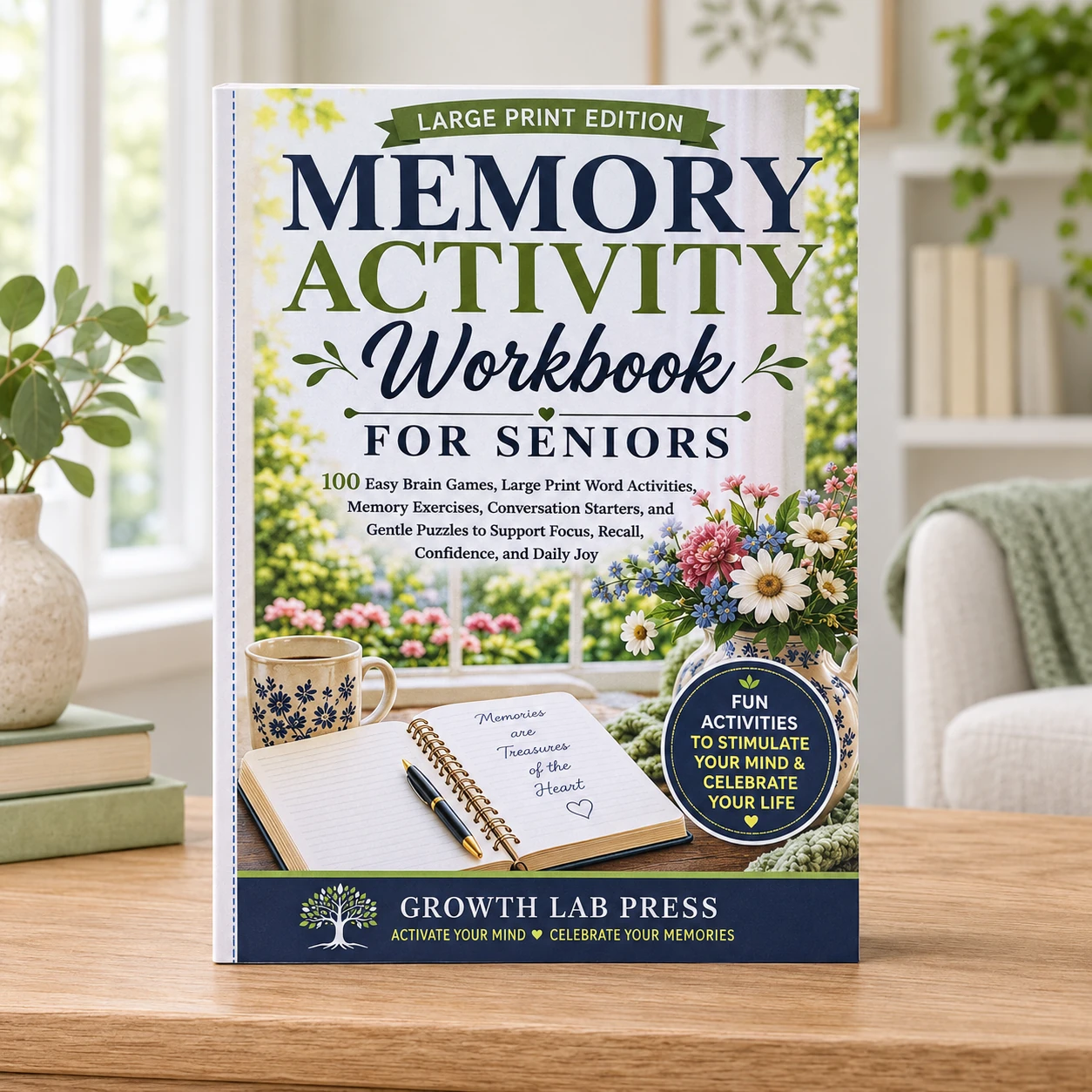
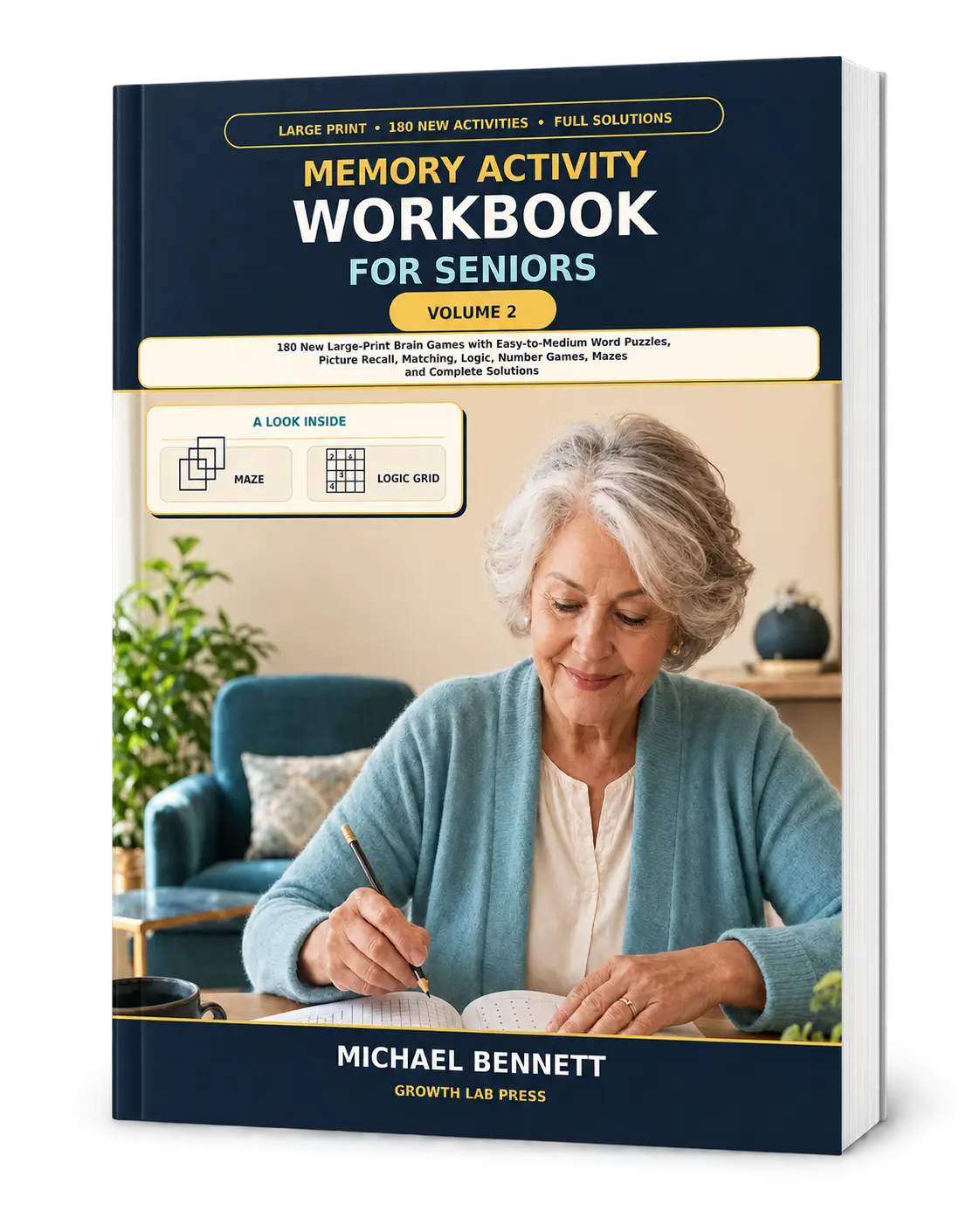
Memory Activity Workbook for Seniors by Michael Bennett is a large-print paperback with memory recall activities, word games and trivia, everyday prompts, conversation starters, reflection pages and spacious writing pages. Memory Activity Workbook for Seniors, Volume 2 contains 180 large-print word, number, matching, visual, logic, planning and maze activities in 12 chapters, with an easy-to-medium progression and complete solutions; its current product page lists paperback and hardcover formats.
Use the linked product pages to inspect the real covers, photographs and current details. The fictional flyer, six activities and answer sets above were created for this article and are not presented as pages from either workbook.
Common questions
Do I need a real grocery flyer for this senior activity?
No. Copy the fictional practice flyer in this article onto one large-print page, or create a shorter version with six familiar items.
Can the grocery-flyer activity work without writing?
Yes. Read the choices aloud and let the participant point, answer verbally, sort section cards or ask a partner to record the list.
How can I make the price puzzles easier?
Show only the two relevant prices, allow a calculator or coins and let a partner do the arithmetic while the participant chooses the items.
Does this activity provide grocery or nutrition advice?
No. The flyer and prices are fictional. For real shopping, food choices, allergies or meal plans, follow the person's preferences, care plan and qualified professional guidance.
Sources and further reading
Published by Growth Lab Press. Read our editorial standards.