Senior activities
How to Use a Restaurant Menu for a 20-Minute Senior Activity
Turn a restaurant menu into a flexible 20-minute senior activity with six games, a fictional large-print menu, checked answers and conversation prompts.
Activities 1 and 2: find an item and sort the menu
Activity 1 — menu finder: ask one question at a time. Try, 'Which drink costs $3?', 'Can you find the chicken dish?' and 'Which dessert begins with A?' Let the participant point, say the answer or read the line aloud.
Activity 2 — sort by section: write STARTER, MAIN, DESSERT and DRINK on four cards. Read an item and ask where it belongs. Start with Tea, Chicken pie, Tomato soup and Berry sundae before adding the remaining items.
Keep the menu visible, offer two choices when useful and treat finding the information as the game.
Show answers or guidance
Activity 1 answers: Tea costs $3. Chicken pie is the chicken dish. Apple crumble is the dessert beginning with A. Activity 2 answers: Tea is a drink; Chicken pie is a main dish; Tomato soup is a starter; Berry sundae is a dessert.
Activity 3: choose a three-course meal
Invite the participant to choose one starter, one main dish and one dessert. There is no correct combination. Ask which item they would choose first and whether they would add Tea or Lemonade.
For a second round, add a playful condition: choose a meal with no repeated first letter, choose the lowest-priced item in each course or make a menu for an imaginary guest. Personal preference is the answer, so avoid correcting the choice.
Conversation follow-up: 'What restaurant meal do you remember enjoying?', 'Who was with you?' or 'Which dish would you add to this menu?' Skip personal questions if the participant prefers the sorting game.
Activity 4: try five simple menu price puzzles
Keep the fictional menu visible and allow paper, a calculator or counting aloud. Read one question at a time.
- 1. Which main dish has the lowest price?
- 2. What is the total for Chicken pie and Tea?
- 3. What is the total for Baked fish and Lemonade?
- 4. How much more does Berry sundae cost than Apple crumble?
- 5. What is the total for two Apple crumbles?
Show answers or guidance
1. Garden salad at $9. 2. Chicken pie $12 + Tea $3 = $15. 3. Baked fish $14 + Lemonade $4 = $18. 4. Berry sundae $8 − Apple crumble $7 = $1. 5. Two Apple crumbles cost $7 + $7 = $14.
Activity 5: play a menu word hunt
Use the same menu as a short reading and word game. The answers stay on the page, so there is no need to remember the whole list.
- 1. Find the two menu items whose first word begins with B.
- 2. Find the item containing the word Garden.
- 3. Find the three-letter drink.
- 4. Find the dessert whose first word begins with A.
- 5. Find all the main dishes whose names have two words.
Show answers or guidance
1. Baked fish and Berry sundae. 2. Garden salad. 3. Tea. 4. Apple crumble. 5. Chicken pie, Baked fish and Garden salad.
Make the menu activity easier or more challenging
To simplify, show one menu section at a time, cover the prices and offer two answer choices. Read each item aloud and let the participant point. For a person who prefers not to write, a partner can mark choices or calculate totals when asked.
To add challenge, ask for a meal below a fictional budget, sort items from lowest to highest price or create a new alliterative dish such as Maple Muffin. Keep the instruction visible and avoid requiring several steps from memory.
For a group, give each person a turn choosing a course or asking the next menu-finder question. Use one shared answer key rather than scoring individuals. If real food will be ordered or served in a care setting, follow the person's care plan and the setting's guidance.
A ready-to-use 20-minute menu visit plan
Minutes 0–3: show the practice menu and ask which section looks most interesting. Minutes 3–7: try three menu-finder questions and sort four items by section.
Minutes 7–12: choose a three-course meal or solve two price puzzles. Minutes 12–17: try the word hunt or add one new dish. Minutes 17–20: ask which activity the person preferred and save the menu for another visit.
The timing is flexible. A five-minute conversation about one remembered restaurant can be enough, while someone who enjoys numbers may want more price questions.
Add large-print activities for more variety
Our large-print activity-book guide explains how to compare type size, spacing, instructions and answer sections. Our memory-activity-book guide helps families and caregivers match activity style, interests, support level and setting to the reader.
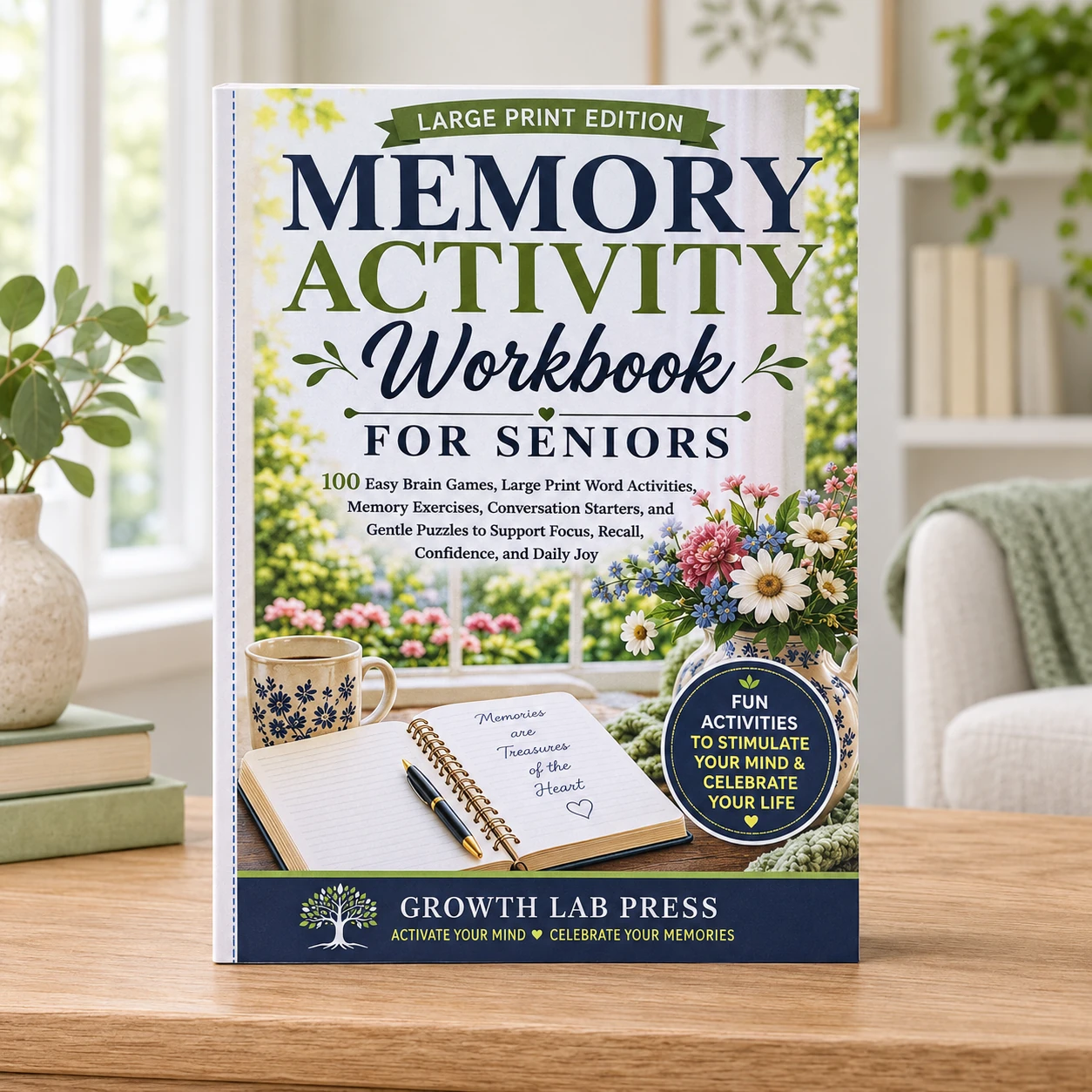
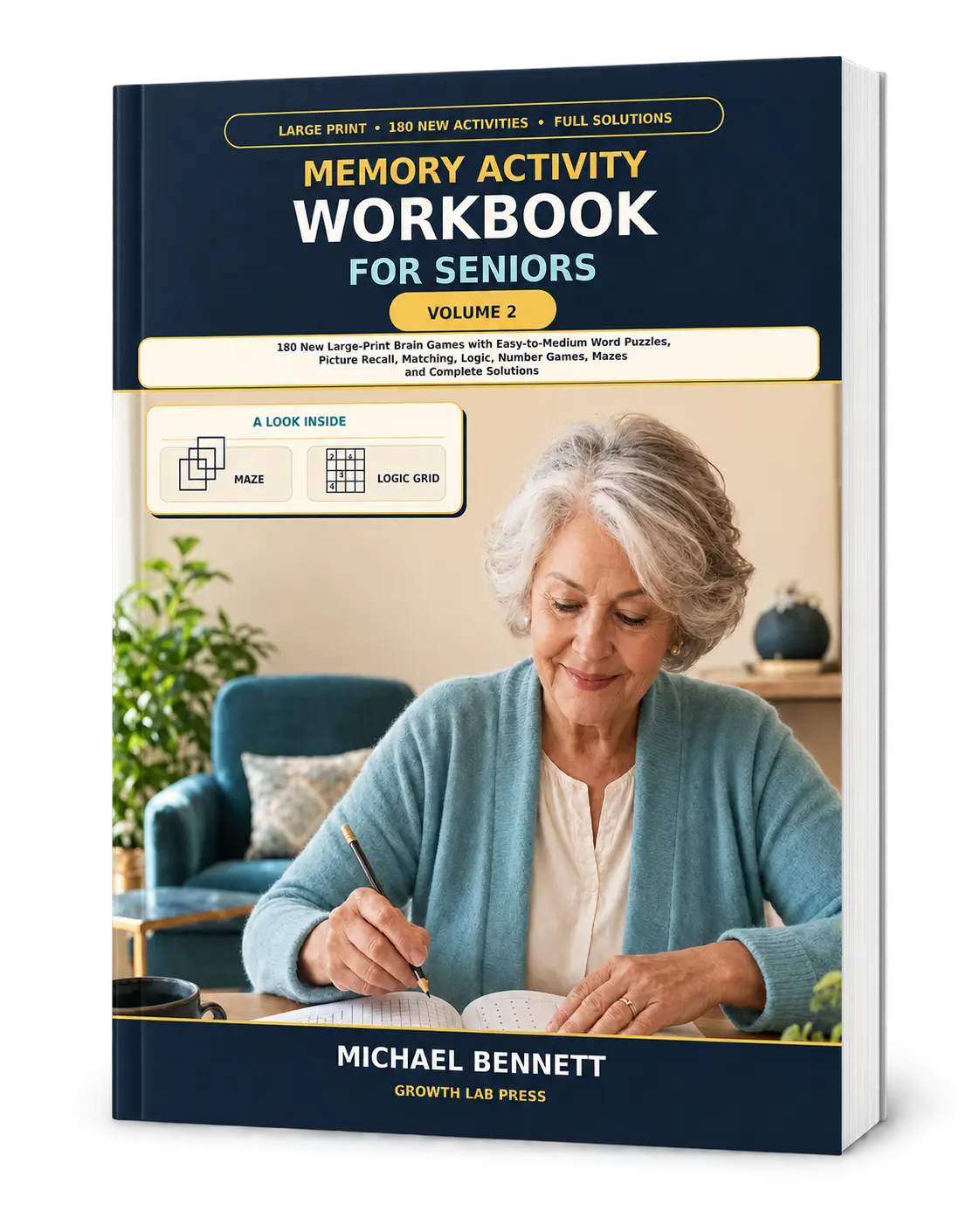
Memory Activity Workbook for Seniors by Michael Bennett is a large-print paperback with memory recall activities, word games and trivia, everyday prompts, conversation starters, reflection pages and spacious writing pages. Memory Activity Workbook for Seniors, Volume 2 contains 180 large-print word, number, matching, visual, logic, planning and maze activities in 12 chapters with an easy-to-medium progression and complete solutions; its current product page lists paperback and hardcover formats.
Use the linked product pages to inspect the real covers, photographs and current details. The fictional menu, six activities and answer sets above were created for this article and are not presented as pages from either workbook.
Common questions
Do I need a real restaurant menu for this senior activity?
No. Use the fictional practice menu in this article or create a one-page menu with a few familiar items in clear large print.
Can the menu activity work without writing?
Yes. Read the choices aloud and let the participant point, answer verbally, sort large-print cards or ask a partner to record the choices.
Should food be served during the activity?
It is not necessary. The menu can be used only for reading, choosing and conversation. If food will be served, follow the person's preferences, care plan and the setting's guidance.
How can I make the price questions easier?
Use only two items, cover the other prices and allow a calculator or coins. A partner can do the arithmetic while the participant chooses the meal.
Sources and further reading
Published by Growth Lab Press. Read our editorial standards.